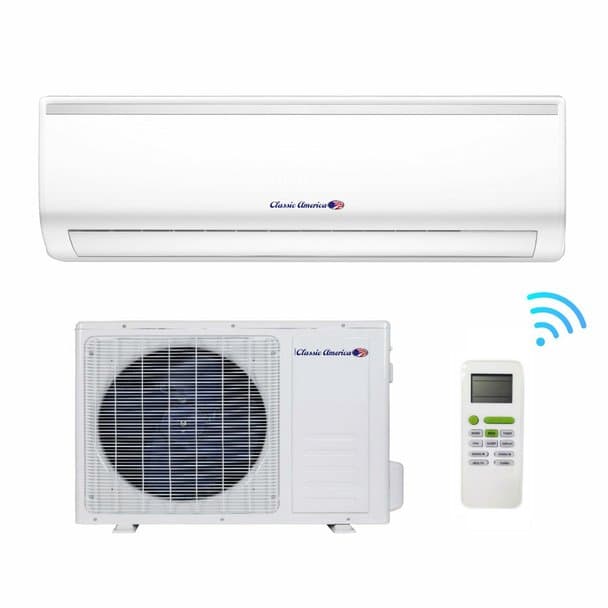
Mini Split Heat Pump: Heating Is Not a Copy of the Cooling BTU
Classic AmericaOct 21st 20268 min read
““Mini split heat pump,” “heat pump mini split,” and “ductless mini split heat pump” all mean the same machine.”
From this article
The short answer
- A mini split heat pump is a ductless system: an outdoor unit and one or more indoor heads that cool and heat. Every Classic America mini split in our catalog is a heat pump. Our window units aren't.
- Heating BTU isn't the same as cooling BTU. On the 9,000 BTU model, the spec sheet lists 9,000 BTU/h of cooling and 9,500 BTU/h of heating at 47°F.
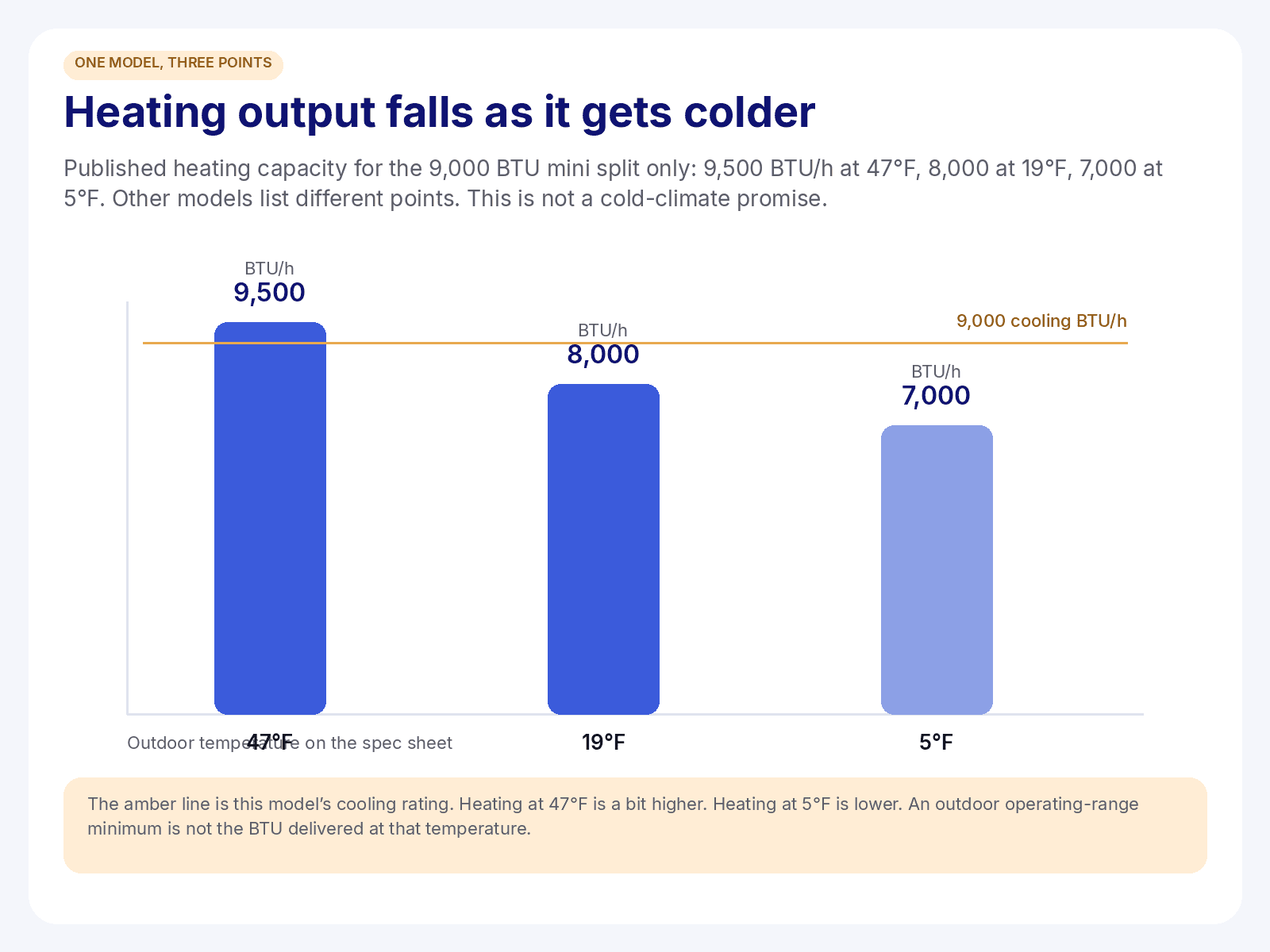
- Output drops in colder weather. That same sheet lists 8,000 BTU/h at 19°F and 7,000 at 5°F. Those figures belong to that one model; they aren't a cold-climate rating for the whole lineup.
- An outdoor operating minimum, like −13°F where a sheet lists one, means the unit is allowed to run at that temperature. It's not the amount of heat it delivers there.
- Size for both cooling and heating in the Size Finder. If this will be your only heat, have a licensed HVAC professional confirm the load.
What a ductless mini split heat pump is
“Mini split heat pump,” “heat pump mini split,” and “ductless mini split heat pump” all mean the same machine. One outdoor unit connects to one indoor head (single zone) or, in our lineup, two heads (DUET). Refrigerant carries heat out of the room in summer and into the room in winter, with no ducts needed.
It isn't a furnace, and it isn't a window unit with a heat strip. If you're comparing cooling-only options, see window AC vs mini split. Our mini split heat pump hub brings together the systems that do both. A single-zone system serves one room. If you have two rooms that each need their own temperature, check out the multi zone mini split guide rather than asking one head to reach around a corner.
SEER2, where the spec sheet lists it, is the cooling-season efficiency rating, so it doesn't tell you anything about heating. Our confirmed figures are 23, 19, 17, and 24 on DUET (non-ducted, not 24.5). The 23,000 BTU sheet is rated 17 SEER2. Our what SEER2 means page goes into more detail. HSPF2 is the heating-season efficiency number, and it isn't the BTU you'll feel at 5°F either.
Heating capacity is not the cooling BTU
The ton conversion in our BTU to tons guide is for cooling: one ton is 12,000 BTU/h of cooling. Heating has its own line on the spec sheet, and on several models it's a little higher than cooling at a mild outdoor temperature. That gap is a nameplate difference, not extra heat you can count on in January.
| Model | Cooling | Heating on the sheet |
|---|---|---|
| 9,000 BTU | 9,000 | 9,500 at 47°F · 8,000 at 19°F · 7,000 at 5°F |
| 12,000 BTU, 19 SEER2 | 12,000 | 12,200 at 47°F · 8,600 at 5°F · no 17°F point |
| 12,000 BTU class, 17 SEER2 | 11,500 | 11,500 at 47°F · 6,800 at 17°F · see note on 5°F |
| 23,000 BTU | 23,000 | 22,400 at 47°F · 13,500 at 17°F · 12,000 at 5°F (max) |
| DUET | 18,000 | 20,000 at 47°F and at 17°F · 16,000 at 5°F · published ducted values on the sheet |
Take a close look at the 17 SEER2 row. The spec sheet lists 6,800 BTU/h at 17°F and also prints 8,000 BTU/h at 5°F, which is higher than the 17°F figure. Our spec notes flag that as an unresolved oddity. We're sharing it as printed, but we don't take it as proof that the unit heats harder when it's colder.
DUET’s cold-weather figures are labeled on the spec sheet as published ducted values, and in that source the 17°F figure matches the 47°F figure. That's what the sheet says. It doesn't mean wall-mounted heads keep their full heating capacity at 17°F, and it isn't a cold-climate certification. That system's non-ducted efficiency is 24 SEER2, not 24.5.
How output drops in winter
The chart at the top shows only the 9,000 BTU model, because its spec sheet has three clear data points: 9,500 BTU/h at 47°F, 8,000 at 19°F, and 7,000 at 5°F. The shape is what matters. When the air is colder, there's less heat outside to move indoors, so the heating BTU you get goes down. Other models can't borrow those three numbers, though. The 19 SEER2 12,000 BTU sheet jumps from 12,200 at 47°F to 8,600 at 5°F, with no 17°F point in between. The 23,000 BTU sheet lists 22,400 BTU/h at 47°F, 13,500 at 17°F, and 12,000 at 5°F (max).
Questions like “how does a mini split heat pump work in winter” and “why is my mini split heat pump freezing up in winter” are answered right here. In heat mode, the outdoor coil can frost over, and the system defrosts it. Our DF defrost code page explains that this is normal: the fan stops or runs very low so it doesn't blow cold air, and the cycle takes a few minutes. A coil that stays iced, or a fault code other than defrost, means it's time for service. We won't turn defrost into a cold-weather performance claim.
What we won't claim
- We don't call any model a cold-climate or hyper-heat system.
- An operating minimum isn't the BTU you'll get. Several spec sheets list heating operation down to about −13°F or −4°F. That means the unit is allowed to run, not how much heat it puts out.
- The 23,000 BTU model’s outdoor heating range on the spec sheet is 5°F to 86°F. Its heating capacity is 22,400 BTU/h at 47°F, 13,500 at 17°F, and 12,000 at 5°F (max). It's rated 17 SEER2.
- Please don't size for winter heat using the cooling ton. Use the Size Finder, and if this will be your only heat, have a licensed HVAC professional confirm the load.
Those points are one sheet, not a winter guarantee. The free Size Finder estimates the heating load and checks it against published heating capacity. If this will be the only heat, have a licensed HVAC professional confirm it.
Operating range is not delivered heat
Manufacturers print two different kinds of temperature. One is capacity at a specific outdoor temperature, which is what the BTU rows in the table show. The other is the range of outdoor temperatures the unit is designed to run in. Mixing them up is how a −13°F footnote turns into a hope of full output on the coldest night.
Here are the published outdoor heating ranges: about −13°F to 86°F on the 9,000 BTU model, −4°F to 86°F on the 19 SEER2 12,000 BTU model, 5°F to 86°F on the 17 SEER2 model, 5°F to 86°F on the 23,000 BTU model, and −13°F to 86°F on DUET. Stay within the range for your model, and remember that the bottom of the range isn't the BTU rating.
Single-zone heat pump or two rooms
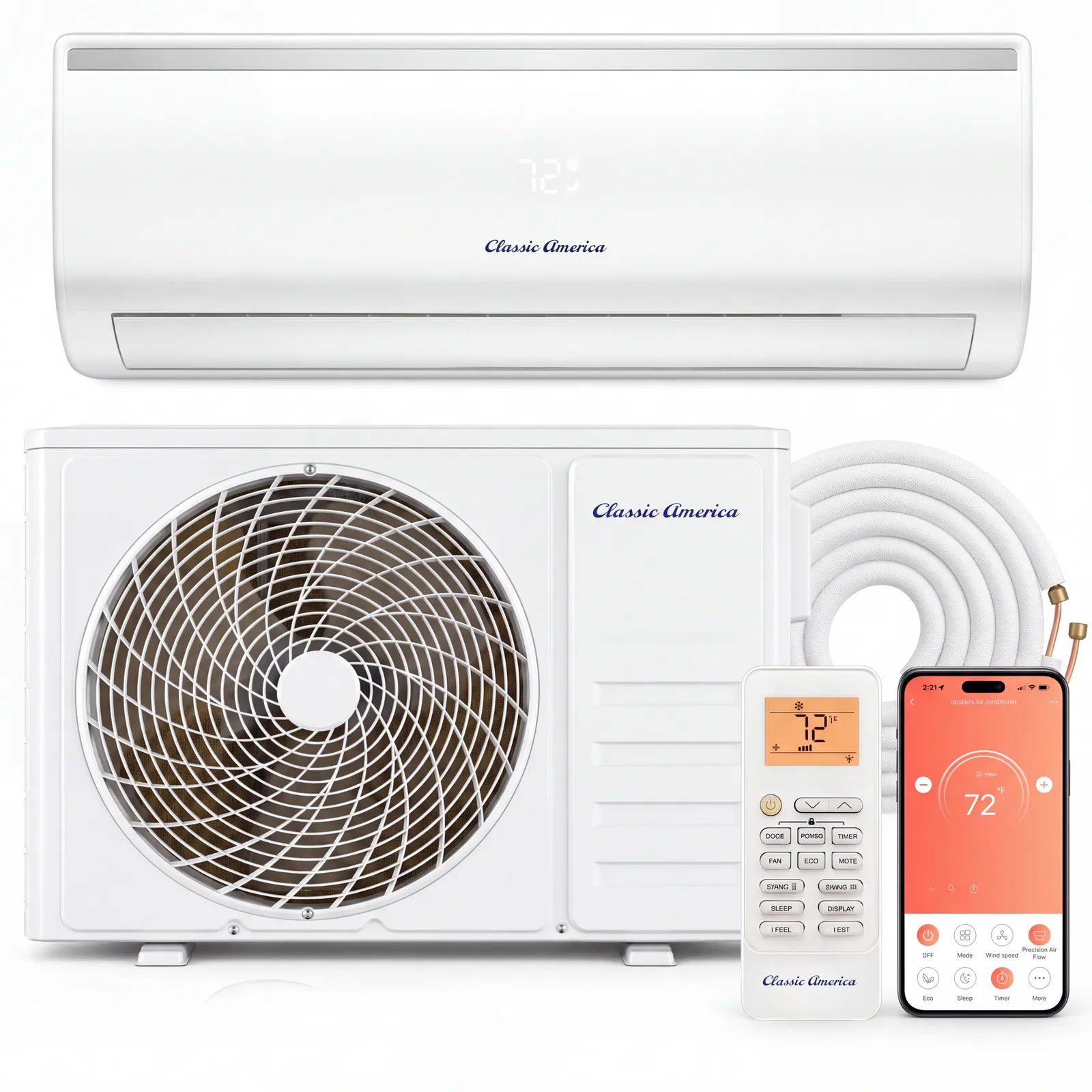
One room, one head. The 9,000 BTU mini split is our small-room heat pump: 9,000 BTU/h cooling, 9,500 heating at 47°F, 23 SEER2, 115V, covering up to about 400 square feet. The 19 SEER2 12,000 BTU mini split delivers 12,000 / 12,200 at 47°F, 19 SEER2, 115V, covering up to about 550 square feet. The 17 SEER2 12,000 BTU mini split delivers 11,500 cooling and 11,500 heating at 47°F, 17 SEER2, covering up to about 550 square feet. The 23,000 BTU mini split is our large single zone: 23,000 cooling, a 22,400 heating nameplate, 208/230V, coverage up to 1,400 square feet, and 17 SEER2.
From the spec sheet
- 9,000 BTU/h cooling · 0.75 ton
- 23 SEER2
- 115V
- Up to 400 sq ft
- Heating nameplate 9,500 BTU/h
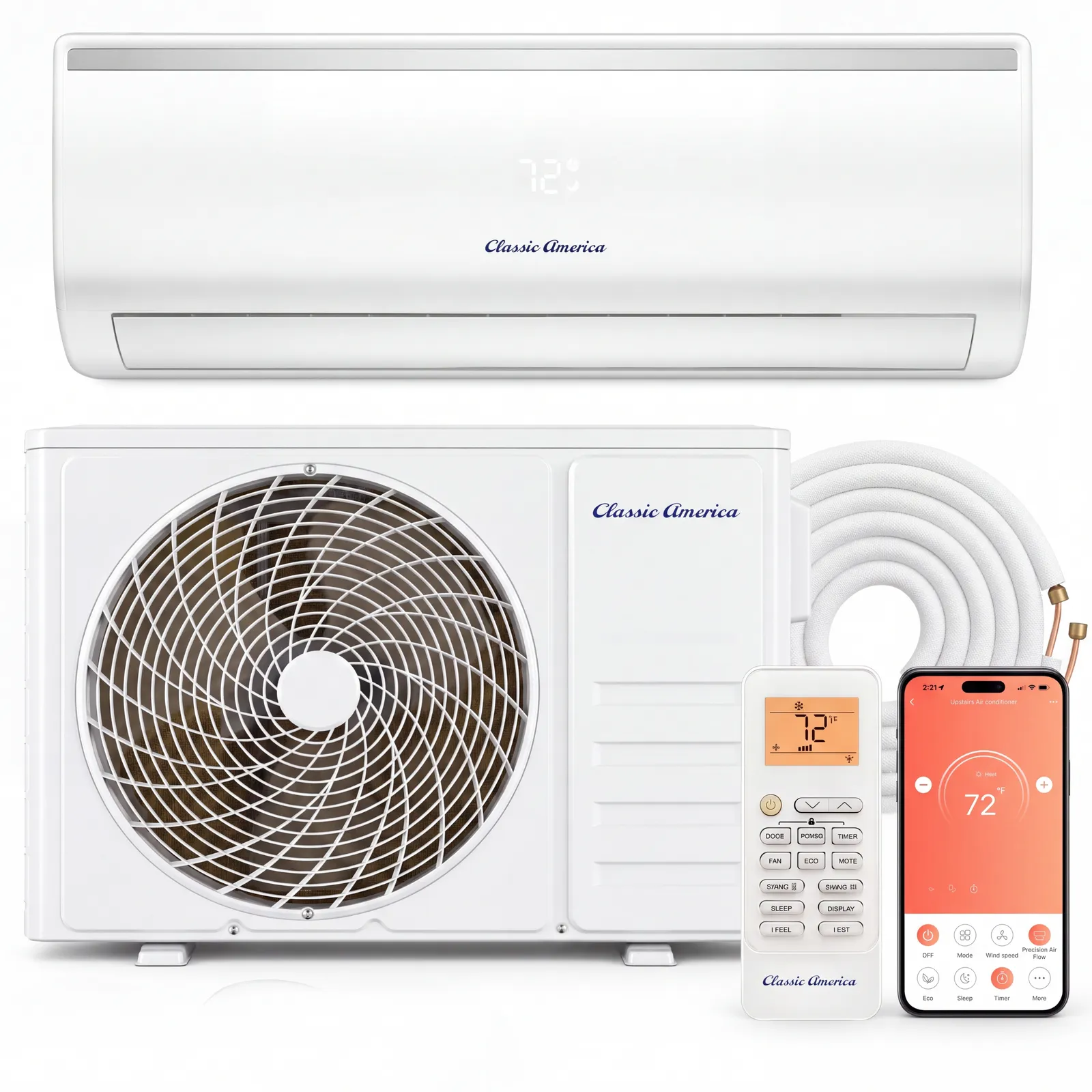
From the spec sheet
- 12,000 BTU/h cooling · 1 ton
- 19 SEER2
- 115V
- Up to 550 sq ft
- Heating nameplate 12,200 BTU/h
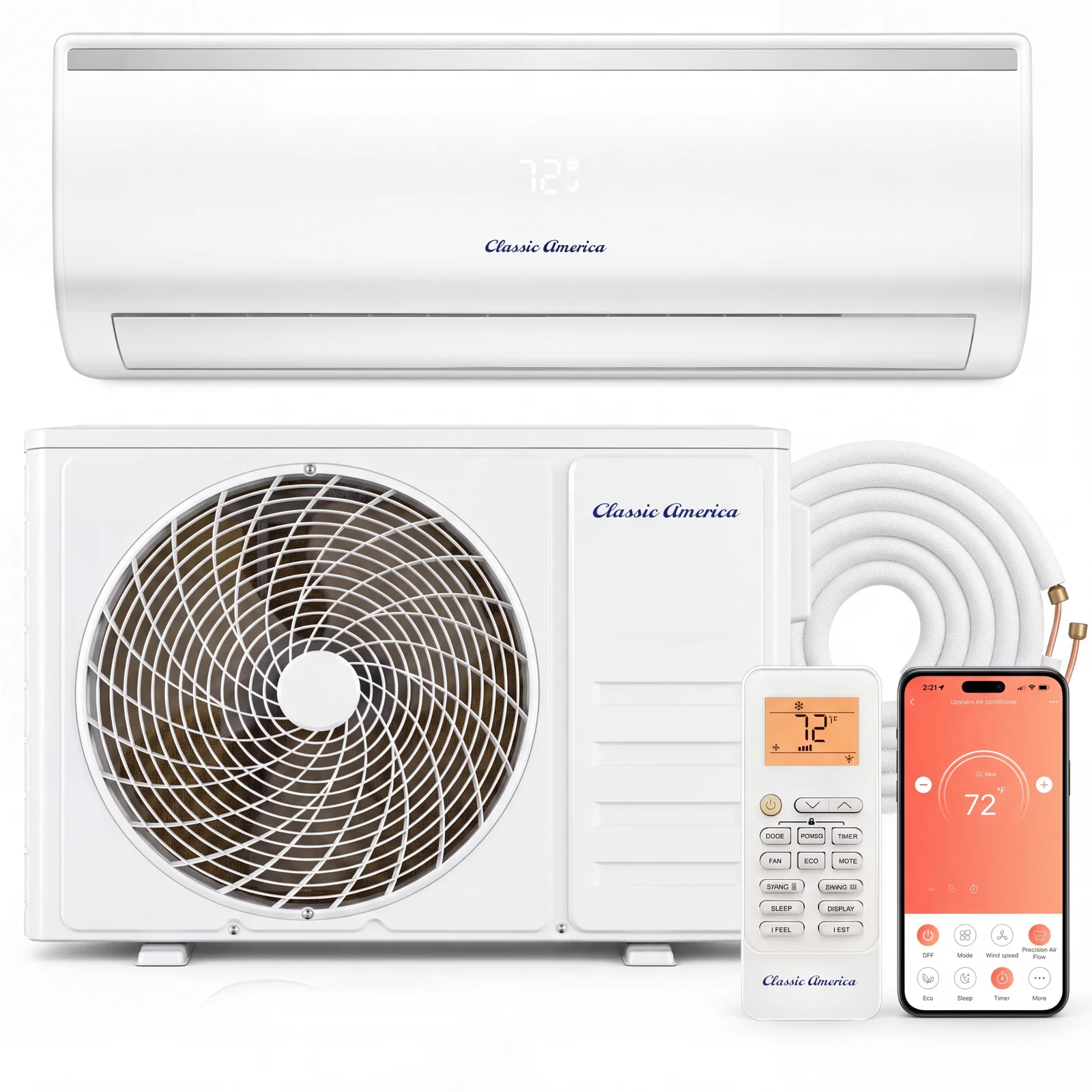
From the spec sheet
- 23,000 BTU/h cooling · 1.92 tons
- 17 SEER2
- 208/230V
- Up to 1,400 sq ft
- Heating nameplate 22,400 BTU/h
For two rooms that each want their own temperature, there's DUET: 18,000 BTU/h cooling, a 20,000 heating nameplate, two 9,000 BTU heads, 208/230V, and 24 SEER2 non-ducted. DUET covers 2 rooms, up to 400 sq ft each, so add each room in the Size Finder. Our dual-zone buying guide helps you decide when it's the right buy, and the dual-zone hub has the product.
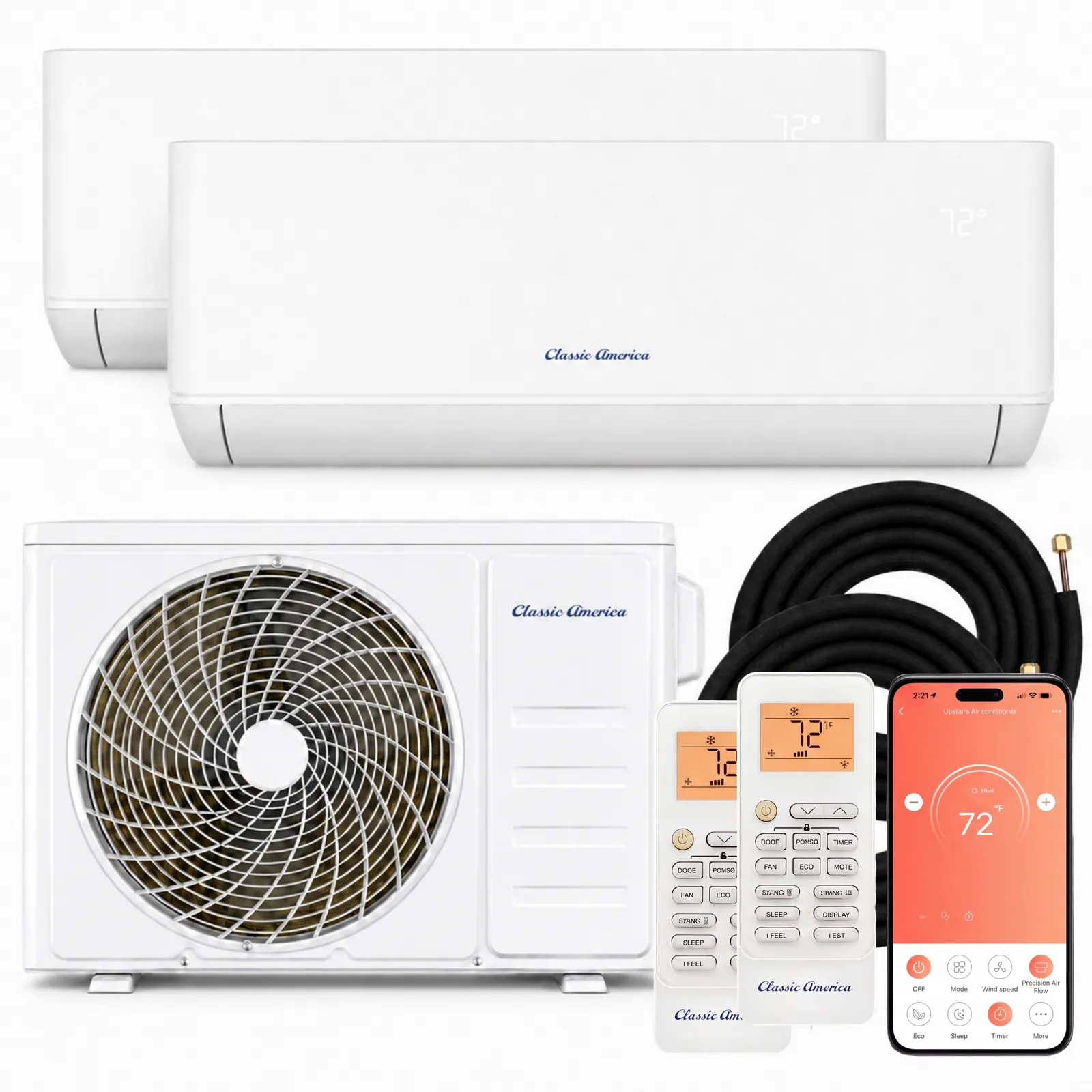
From the spec sheet
- 18,000 BTU/h cooling · 1.5 tons
- 24 SEER2, non-ducted
- 208/230V
- Two 9,000 BTU indoor heads on one outdoor unit
- Heating nameplate 20,000 BTU/h
Size the heating load before you buy
Cooling tons and a square-foot guess both miss winter. A sunny, well-insulated bedroom and a garage with a thin door are very different heating jobs. Our mini split sizing guide explains the adjustments, mini split for a garage covers garages, and the BTU calculator walkthrough shows you how to enter your room. Then open the Size Finder and check the heating result, not just the cooling BTU.
If the mini split will be your main heat, treat the tool as a starting point and have a licensed HVAC professional confirm the load. Planning the mount and the line-set path is reasonable homeowner work, but the refrigerant, vacuum, and dedicated circuit aren't. The Install Planner gives you a handy checklist. The equipment price ranges you see in US roundups are commonly published figures, not our list prices. You'll find them in how much a mini split costs, separate from mini split installation cost.
These systems come with 5 years on the compressor and 1 year on parts.
FAQ
Common questions
What is a mini split heat pump?
It's a ductless system with an outdoor unit and one or more indoor heads that both cools and heats. Every Classic America mini split in our catalog is a heat pump. Our window units are cooling only.
Is heating BTU the same as cooling BTU?
No. For example, the 9,000 BTU model lists 9,000 BTU/h of cooling and 9,500 BTU/h of heating at 47°F. The 23,000 BTU model lists 23,000 cooling and 22,400 heating as nameplate figures. Cold-weather output is a separate line, when the spec sheet includes one.
Do mini split heat pumps work in winter?
Yes, they heat in winter, and the published output is lower when it's colder outside. On the 9,000 BTU spec sheet, that's 8,000 BTU/h at 19°F and 7,000 at 5°F. That's one model’s data, not a promise that every unit keeps its mild-weather output. Check the Size Finder for your room.
Why does my mini split heat pump ice up in winter?
Frost on the outdoor coil in heat mode is completely normal, and defrost mode melts it. The DF code is normal too, and the fan may stop briefly. If the unit stays iced or shows a different fault, it needs service. Defrost isn't a cold-weather performance rating.
Does a low outdoor operating temperature mean full heat?
No. The bottom of the operating range isn't the BTU delivered at that temperature. Several spec sheets allow heating operation near −13°F or −4°F and still list much lower capacity at 5°F, or no capacity figure at all.
Is DUET 24.5 SEER2?
No. Its published non-ducted rating is 24 SEER2, and that's a cooling efficiency rating, not winter heating output.
Quick poll