What Is SEER2? The Rating, and How It Differs From SEER
Classic AmericaOct 16th 20268 min read
The short answer
- SEER2 is the seasonal cooling-efficiency rating on new US air conditioners and heat pumps. A higher SEER2 rating means you get more cooling for each unit of electricity over a typical season.
- It isn't just a new name for SEER. New equipment has used the SEER2 test since January 1, 2023, and because the test procedures differ, the numbers aren't interchangeable.
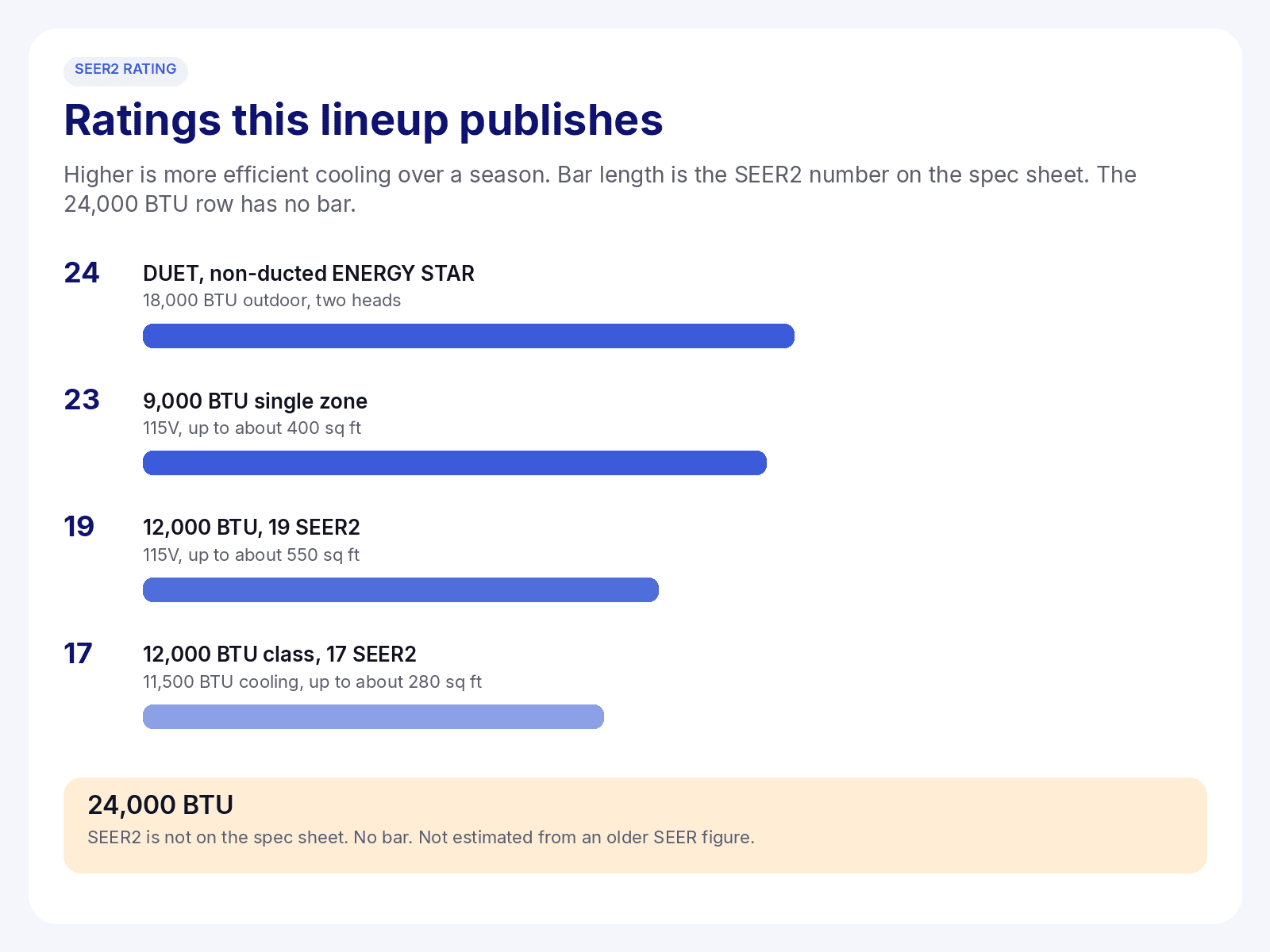
- In our lineup, the confirmed ratings are 23 (9,000 BTU), 19 and 17 (12,000 BTU class), and 24 SEER2 on DUET (non-ducted). That's 24, not 24.5.
- The 23,000 BTU model is rated 17 SEER2. We never make up a SEER2 number by subtracting from an older SEER figure.
- Our window units are rated CEER 10.9, not SEER2. And even a high SEER2 rating won't size your room for you. That's what the Size Finder is for.
What SEER2 means
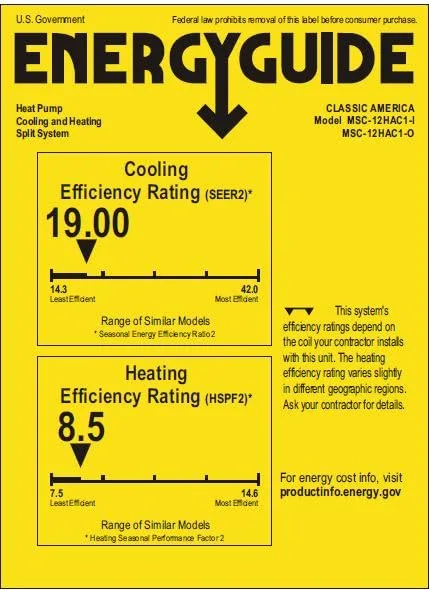
Here's what SEER2 means in plain language: it's how much cooling a system delivers over a typical cooling season, divided by the electricity it uses to do it. SEER stands for Seasonal Energy Efficiency Ratio. The “2” refers to the current Department of Energy test. It doesn't mean a second season or a second kind of ton.
Lots of people search “what is SEER2” because the labels on the box changed. A contractor might still say SEER out of habit, but a product page should say SEER2 when that's the figure on the current spec sheet. Our older SEER explainer covers the older label, and this page covers the rating on equipment sold today.
SEER2 is a cooling-season number, so it doesn't describe heating. When the spec sheet lists heating efficiency, that's HSPF2. How much heat you'll get in winter is a different question, and our mini split heat pump guide covers it.
How to read a SEER2 rating
A SEER2 rating is a ratio, not a capacity, so it won't tell you how many BTU your room needs. Two systems can have the same BTU rating and different SEER2 numbers. Our 12,000 BTU class is a good example: one model is 19 SEER2 with a full 12,000 BTU/h of cooling, and the other is 17 SEER2 with 11,500 BTU/h of cooling on the spec sheet.
A higher number means the system used less electricity in lab testing for the cooling it delivered. It doesn't mean the room will feel colder, and it doesn't mean the unit is the right size. For capacity, see the BTU to tons guide. For your room, try the Size Finder.
If you'd like a bill estimate based on the ratings on the spec sheet, the Energy Savings calculator compares an inverter mini split with the equipment you have now. It won't turn a SEER2 point into a guaranteed dollar savings, though. Any dollar figure you see in a general US article is a commonly published estimate, not a Classic America price.
What is a good SEER2 rating?
What counts as “good” depends on what the spec sheet actually lists, not on a slogan. In our catalog, the confirmed cooling ratings are 17, 19, 23, and 24. Seventeen is the lower of the two systems in the 12,000 BTU class, and it's a published SEER2, not a guess. Twenty-three on the 9,000 BTU model and 24 on DUET (non-ducted) are the top of our range.
There are federal minimums, and they vary by region and by whether the equipment is a heat pump or cooling-only. We won't reprint every regional cutoff here. The number that matters for any model is the one on its spec sheet. And even a rating well above the minimum can be the wrong machine if the BTU don't match your room.
SEER2 vs SEER
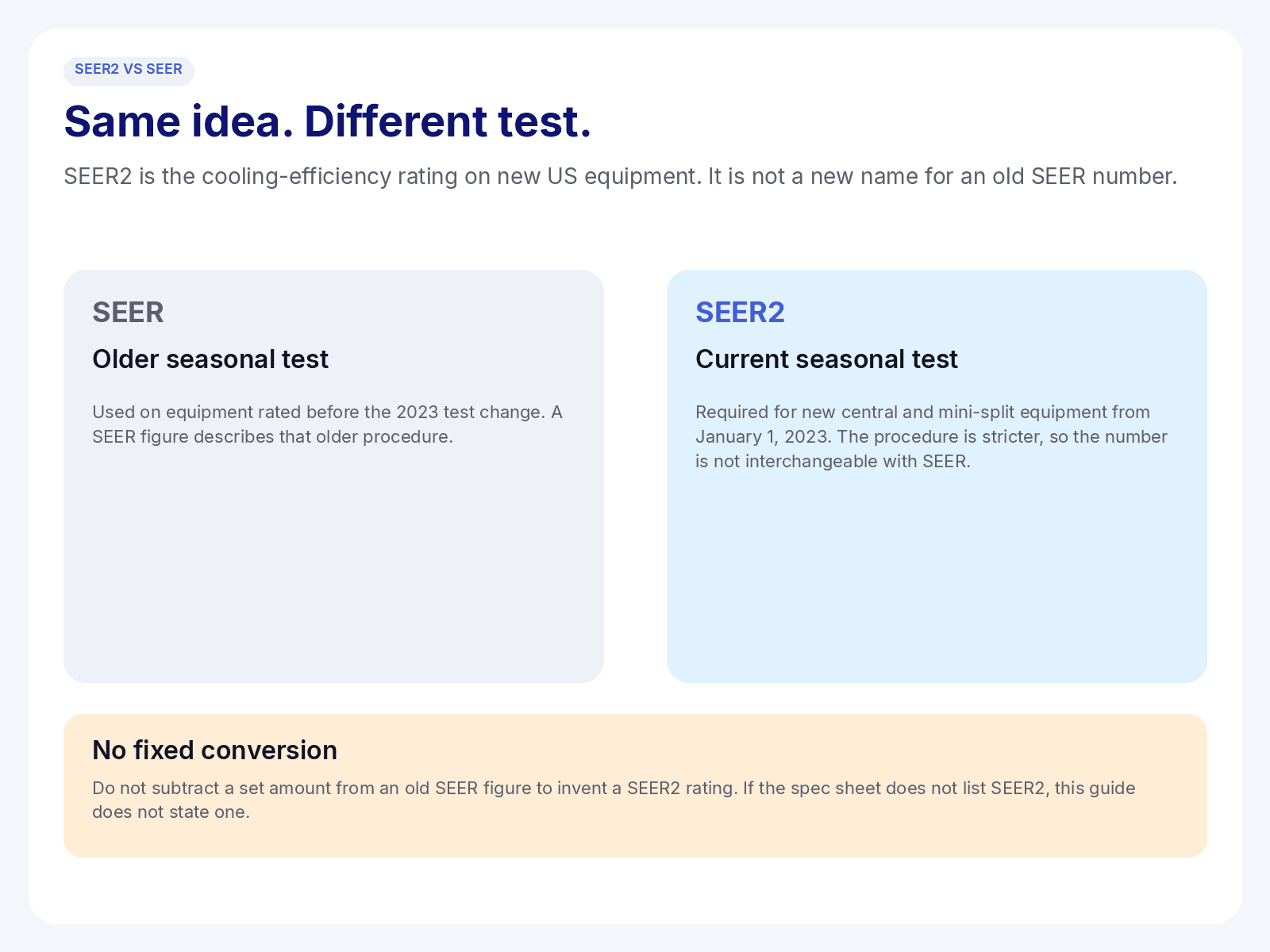
SEER2 vs SEER is a change in the test, not just the name. On January 1, 2023, the US Department of Energy started requiring the updated test (often called Appendix M1) for new central air conditioners and heat pumps. For ducted systems, the lab raises the external static pressure the blower works against, so the rating is closer to a real-world install. Ductless equipment is tested under the updated procedure too.
Since the tests are different, a SEER number and a SEER2 number aren't the same claim. A unit once described as “20 SEER” isn't automatically “20 SEER2.” That's the heart of the question “what is the difference between SEER and SEER2”: same job (seasonal cooling efficiency), different procedure, different number.
Please don't convert your way to a missing rating
- There's no simple subtraction that turns every SEER figure into SEER2. A popular rule of thumb is still just an approximation, and we don't use one here.
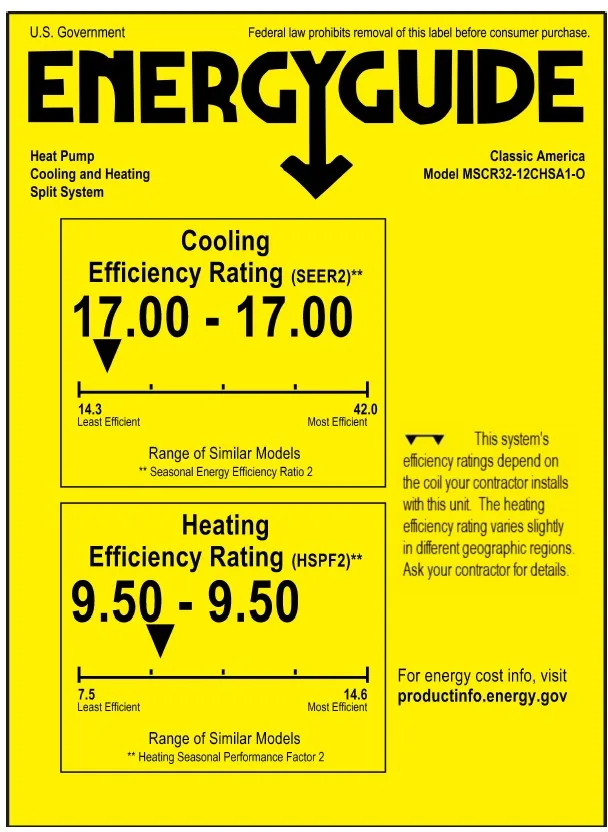
- The 23,000 BTU model is rated 17 SEER2, plus HSPF2 9.5 (Region IV) and 8.5 (Region V). We don't convert an older SEER figure to get that rating.
- DUET’s published non-ducted rating is 24 SEER2, not 24.5. The same spec sheet also lists a separate ducted figure of 20 SEER2. Quote the one that matches how the system is installed. These heads are non-ducted.
- SEER2 doesn't size the room, and it doesn't tell you how much heat you'll get in cold weather.
SEER2 on this lineup
| Model | SEER2 | What else the sheet says |
|---|---|---|
| 9,000 BTU | 23 | 115V · up to about 400 sq ft · 9,000 BTU/h cooling |
| 12,000 BTU, 19 SEER2 | 19 | 115V · 12,000 BTU/h cooling · up to about 550 sq ft |
| 12,000 BTU class, 17 SEER2 | 17 | 115V · 11,500 BTU/h cooling · up to about 550 sq ft |
| DUET, non-ducted | 24 | non-ducted · two 9,000 BTU heads · 208/230V |
| DUET, ducted | 20 | Same outdoor unit, ducted figure on the spec sheet. Not the wall-head install. |
| 23,000 BTU | 17 | 208/230V · 23,000 BTU/h cooling · up to 1,200 sq ft |
| Window 8k and 12k | Not SEER2 | CEER 10.9 · cooling only · 115V plug-in |
The 19 SEER2 model covers up to about 550 square feet, not 600. Its product URL still has an older “600-sqft” phrase in it, so go by the spec sheet. And when your room is sunny, tall, or poorly insulated, trust the Size Finder over either number. Our mini split sizing guide walks through those details, and the BTU calculator walkthrough gives you a click-by-click tour of the same tool.
Compare the models next to the bars. The card for the 23,000 BTU system shows **17 SEER2**.
From the spec sheet
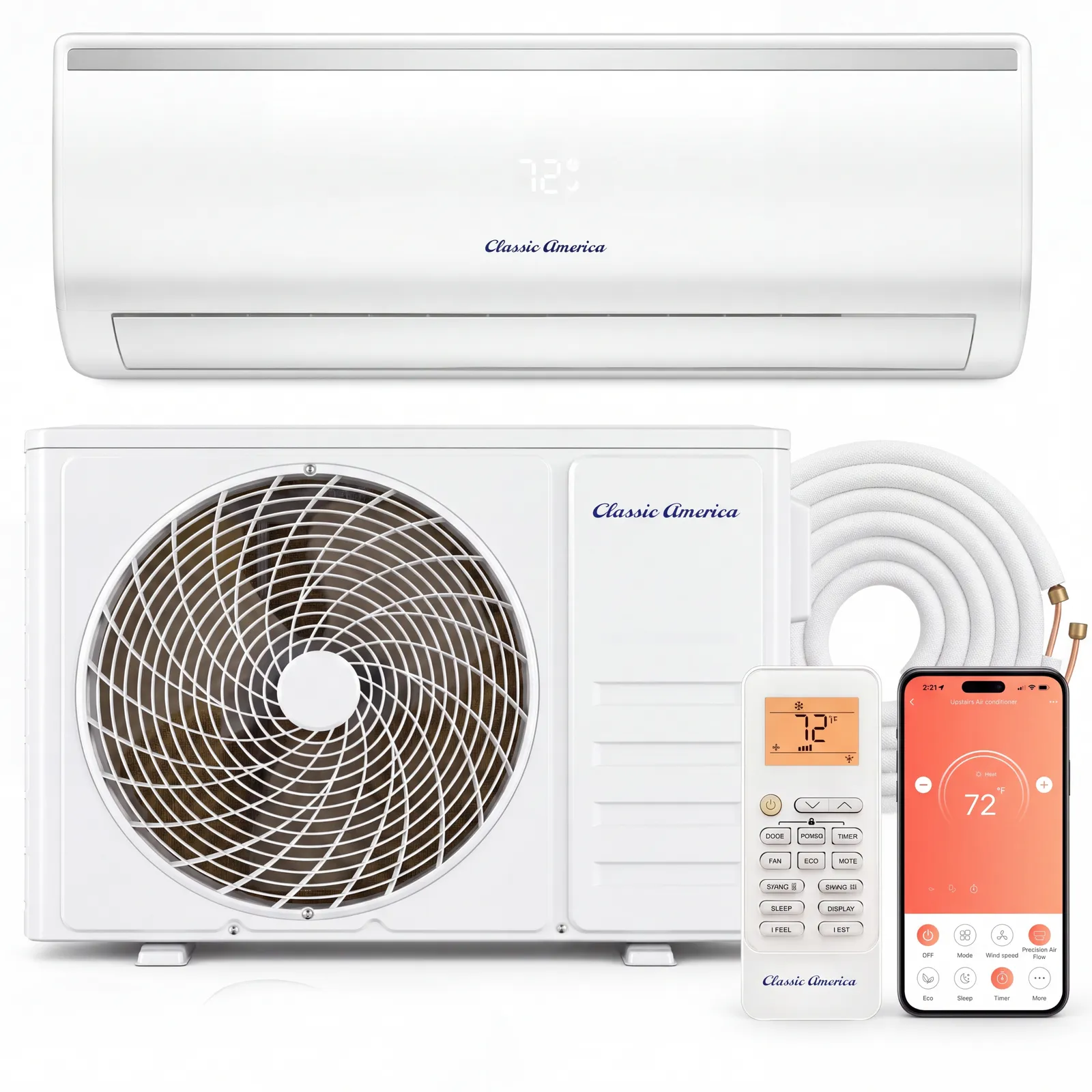
- 9,000 BTU/h cooling · 0.75 ton
- 23 SEER2
- 115V
- Up to 400 sq ft
- Heating nameplate 9,500 BTU/h
From the spec sheet
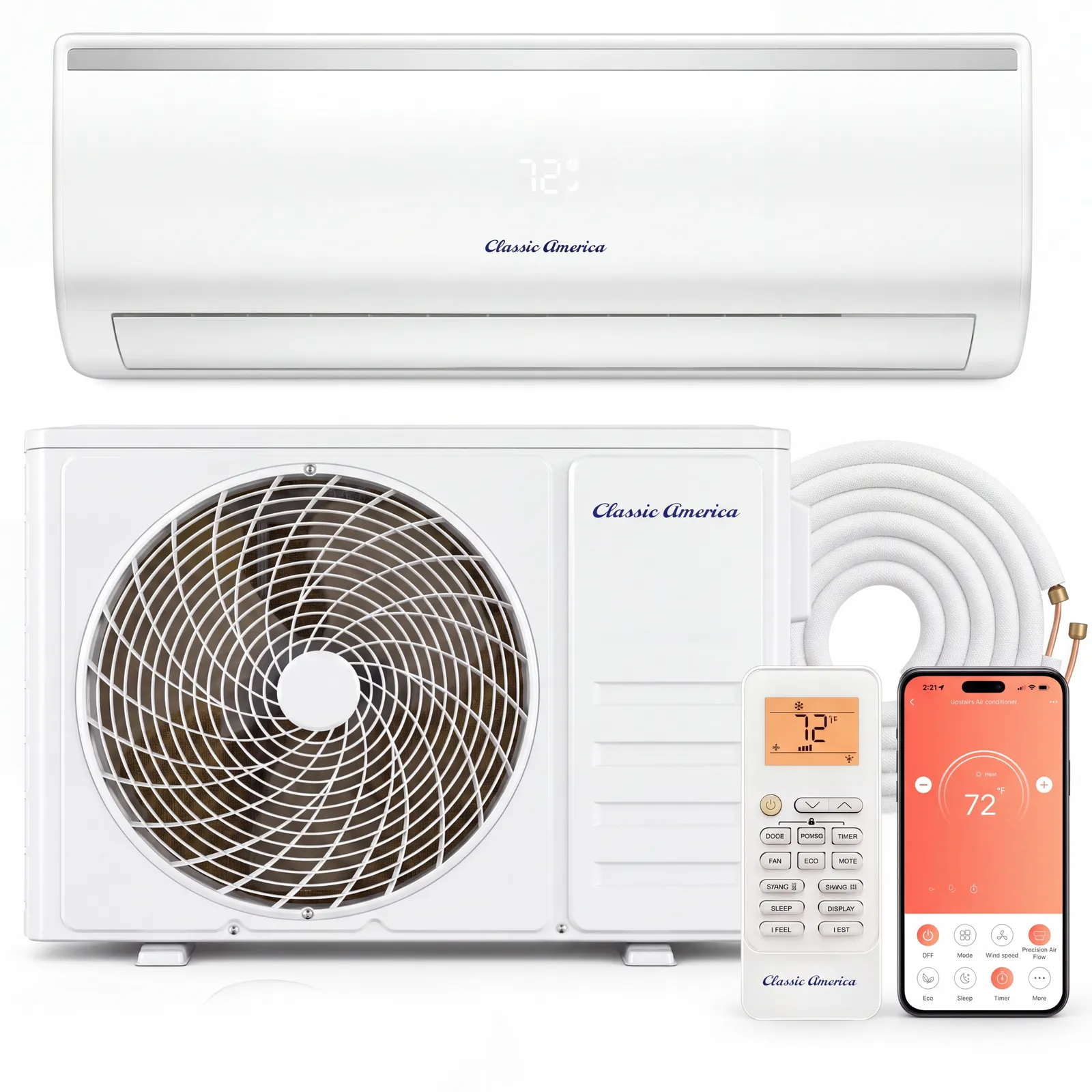
- 12,000 BTU/h cooling · 1 ton
- 19 SEER2
- 115V
- Up to 550 sq ft
- Heating nameplate 12,200 BTU/h
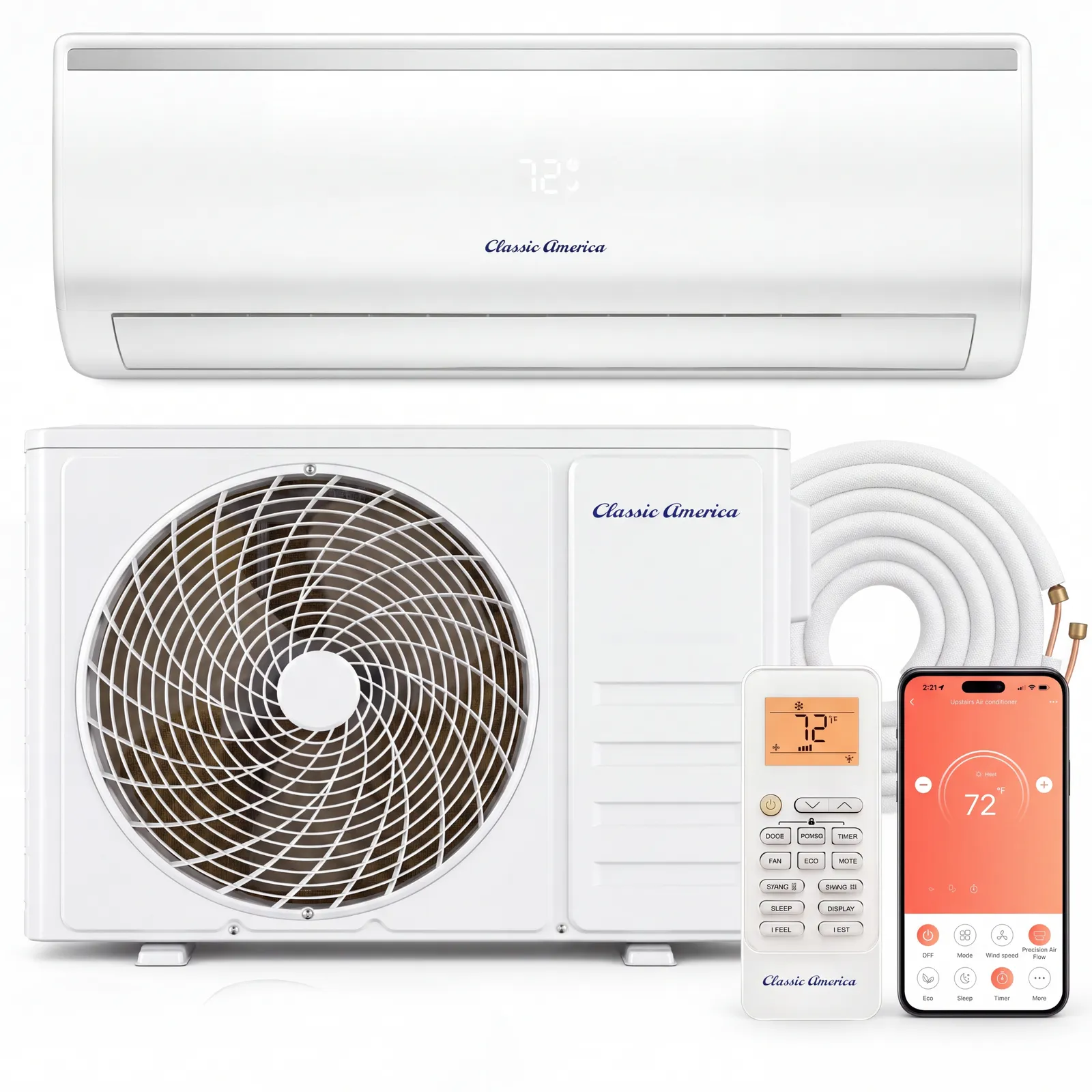
From the spec sheet
- 11,500 BTU/h cooling · 0.96 tons
- 17 SEER2
- 115V
- Up to 550 sq ft
- Heating nameplate 11,500 BTU/h
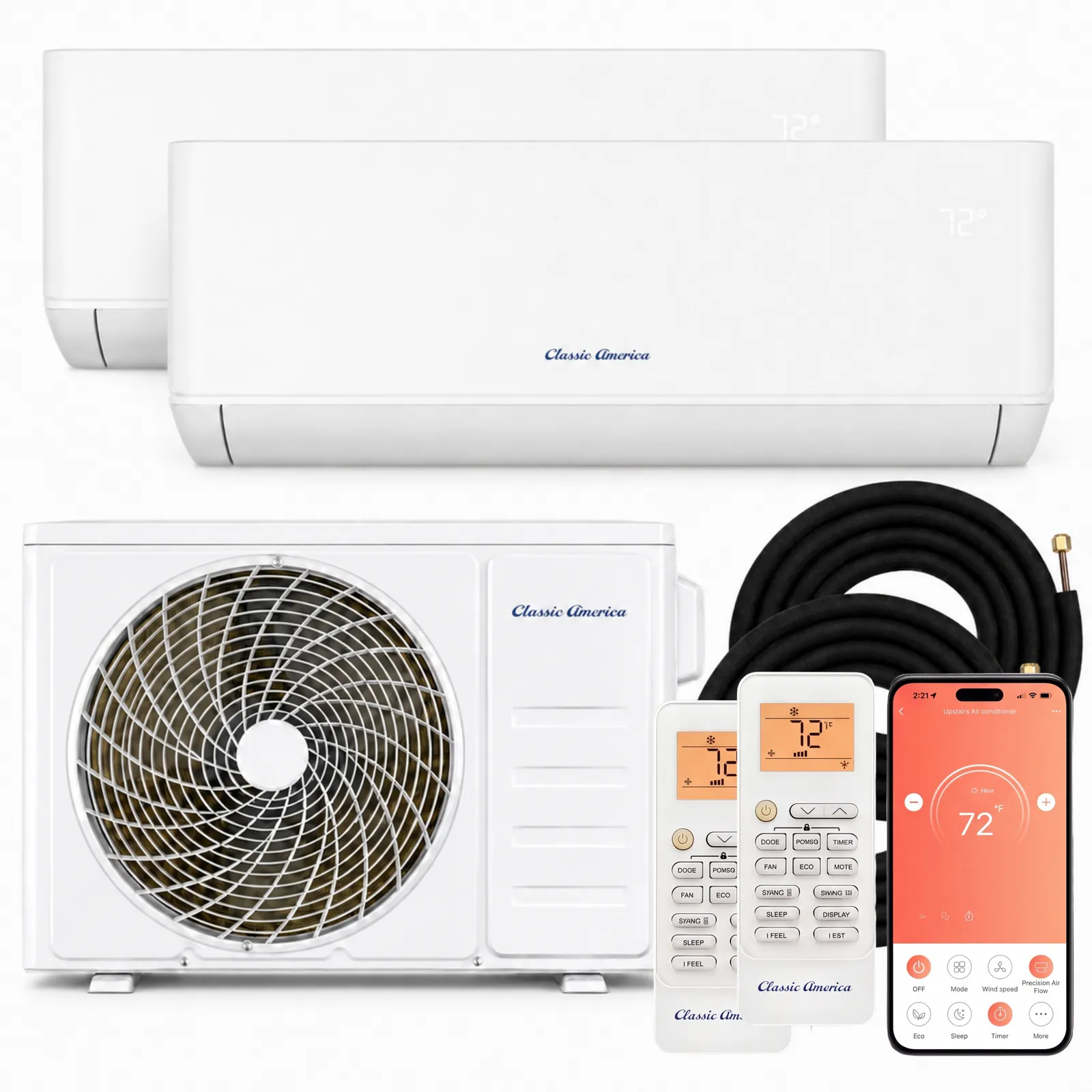
From the spec sheet
- 18,000 BTU/h cooling · 1.5 tons
- 24 SEER2, non-ducted
- 208/230V
- Two 9,000 BTU indoor heads on one outdoor unit
- Heating nameplate 20,000 BTU/h
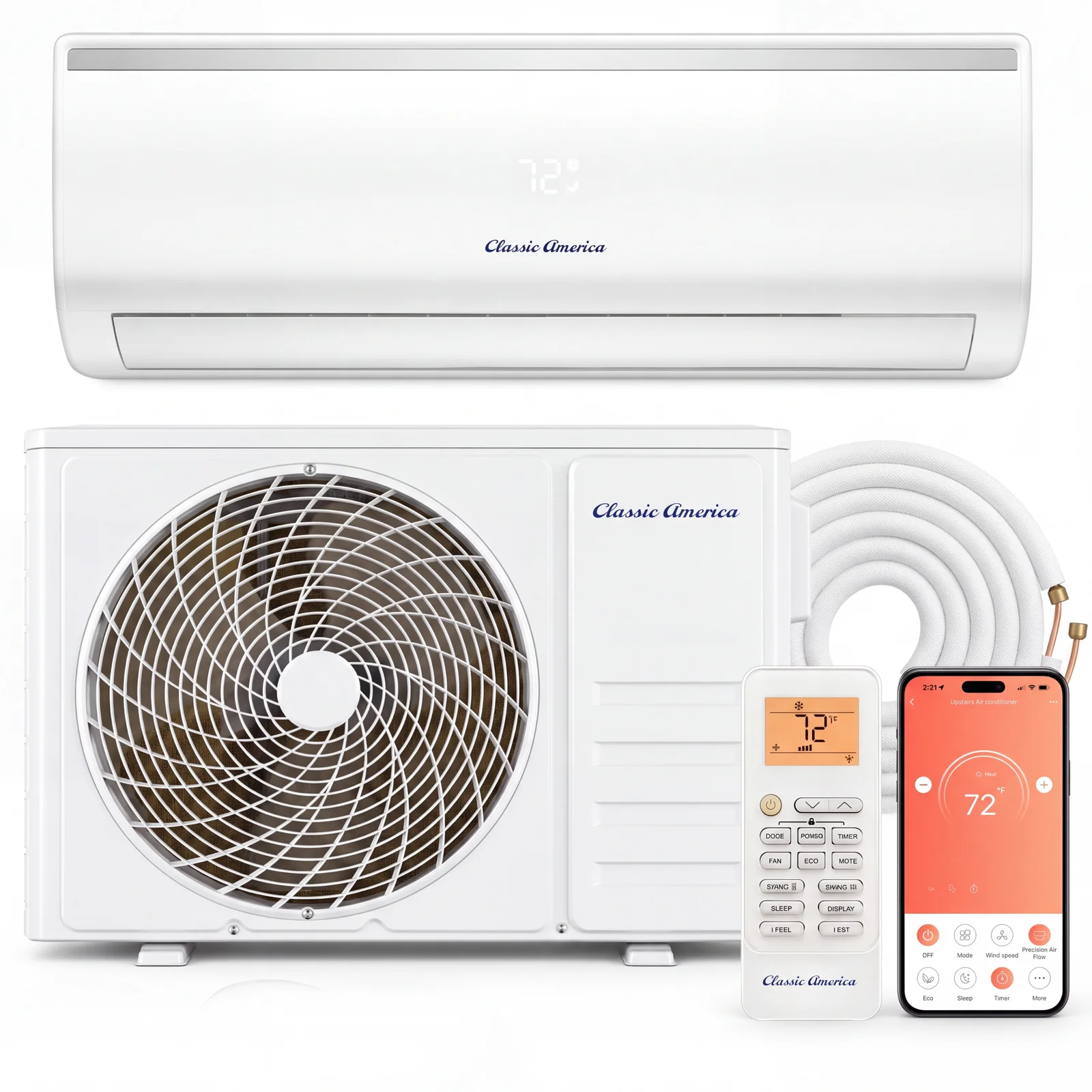
From the spec sheet
- 23,000 BTU/h cooling · 1.92 tons
- 17 SEER2
- 208/230V
- Up to 1,200 sq ft
- Heating nameplate 22,400 BTU/h
The 9,000 BTU mini split is our 23 SEER2 system, on the 9,000 BTU hub. Both 12,000 BTU-class systems are on the 12,000 BTU hub: the 19 SEER2 12,000 BTU mini split and the 17 SEER2 12,000 BTU mini split. You'll find DUET on the dual-zone hub, and the 23,000 BTU mini split, rated 17 SEER2, on the 23,000 BTU / 2 ton hub. Want to see every spec at once? Line them up in the compare tool.
The rating is not the room. The free Size Finder turns sun, ceiling height, insulation, and climate into a BTU number. The Energy Savings calculator is where a SEER2 figure becomes a bill comparison, not a promised discount.
Window units are rated in CEER, not SEER2
The window air conditioners in our catalog don't carry a SEER2 rating. Both the 8,000 BTU window air conditioner and the 12,000 BTU window air conditioner list CEER 10.9. CEER is the combined energy-efficiency ratio used for window units, so calling it SEER2 would mix up two different tests. Our window AC vs mini split comparison keeps the labels straight, along with the plug-in install and the fact that these window units don't heat.
HSPF2 is the heating rating, not SEER2
If the mini split is a heat pump, its spec sheet may also list HSPF2, the heating-season counterpart, often split into Region IV and Region V. Here's what we publish: 9.0 / 7.76 on the 9,000 BTU model, 7.5 / 7.2 on the 19 SEER2 12,000 BTU model, 9.5 / 8.1 on the 17 SEER2 model, and 10.5 / 9.5 non-ducted on DUET (8.5 / 7.33 on the ducted configuration). The 23,000 BTU model is rated HSPF2 9.5 in Region IV and 8.5 in Region V.
HSPF2 still isn't the BTU you'll get on a cold night, because output drops as the outdoor temperature drops. You'll find that chart in the mini split heat pump guide. The Size Finder checks your heating load against the published heating capacity, rather than assuming the cooling BTU will handle both jobs.
What the rating does not decide
Even a great SEER2 rating on an undersized head will leave the room warm on the hottest afternoon, and an oversized head can short-cycle and feel clammy. If your quote came in tons, start with the BTU to tons guide, then run your room through the Size Finder. These systems come with 5 years on the compressor and 1 year on parts. Planning the mount is great homeowner work, while refrigerant connections, the vacuum, and a dedicated electrical circuit are jobs for a licensed HVAC professional.
FAQ
Common questions
What is SEER2?
SEER2 is the current US seasonal cooling-efficiency rating. A higher number means more cooling for each unit of electricity over a typical cooling season. It's been the required test for new central and mini-split equipment since January 1, 2023.
What is the difference between SEER and SEER2?
They measure the same idea using different tests. SEER2 is the current procedure. A SEER number and a SEER2 number aren't interchangeable, and subtracting a fixed amount from SEER won't give you a SEER2 rating.
What is a good SEER2 rating?
In our lineup, the confirmed ratings are 17, 19, 23, and 24 (DUET, non-ducted). Higher is more efficient. Federal minimums vary by region and equipment type. Just remember, a higher rating doesn't mean the unit is the right size for your room.
Is DUET 24.5 SEER2?
No. The published non-ducted rating is 24 SEER2. The same spec sheet also lists 20 SEER2 for a ducted configuration. Wall-mounted heads fall under the non-ducted rating.
Does the 23,000 BTU mini split have a SEER2 rating?
Yes. The 23,000 BTU mini split is rated 17 SEER2. It delivers 23,000 BTU/h of cooling (about 1.9 tons) on 208/230V, with coverage up to 1,200 square feet. We didn't convert an older SEER figure to get that SEER2 number.
Do window air conditioners have a SEER2 rating?
Not these. Our 8,000 and 12,000 BTU window units list CEER 10.9. They're cooling-only, 115V plug-in units. See window AC vs mini split for more.
The lineup
Models in this article
From the spec sheet
- 12,000 BTU/h cooling · 1 ton
- 19 SEER2
- 115V
- Up to 550 sq ft
- Heating nameplate 12,200 BTU/h
From the spec sheet
- 18,000 BTU/h cooling · 1.5 tons
- 24 SEER2, non-ducted
- 208/230V
- Two 9,000 BTU indoor heads on one outdoor unit
- Heating nameplate 20,000 BTU/h