Mini Split for Garage: Sizing, Voltage, and What to Plan
Classic AmericaOct 23rd 202611 min read
The short answer
- A mini split for a garage works when you size it for the garage’s actual load. A big door and light insulation are why the same square footage isn't the same as a living room.
- That's why the Size Finder adds about 25 percent to the cooling estimate for a garage or shop, along with a higher heating factor.
- A 12,000 BTU model can fit a smaller, better-insulated bay when you're mostly cooling. A two-car garage with a thin door often needs the 23,000 BTU system, especially if you want heat.
- Our 9,000 and 12,000 BTU single-zone systems are 115V, and the 23,000 BTU system is 208/230V. The 19 SEER2 12,000 BTU spec sheet says up to about 550 sq ft for a typical room, not a garage.
- Pick Garage or shop in the Size Finder. Planning the mount is great homeowner work, while the refrigerant, vacuum, and circuit are for a licensed pro.
Why a garage is not a living room of the same size
A ductless mini split is a popular way to heat and cool a garage the central system never reached. There's no ductwork to extend, the head serves just that space, and you can run it only when you're out there. But none of that tells you what size to get. Lots of people shop for a garage mini split and then use a living-room chart, and the garage door is why that doesn't work.
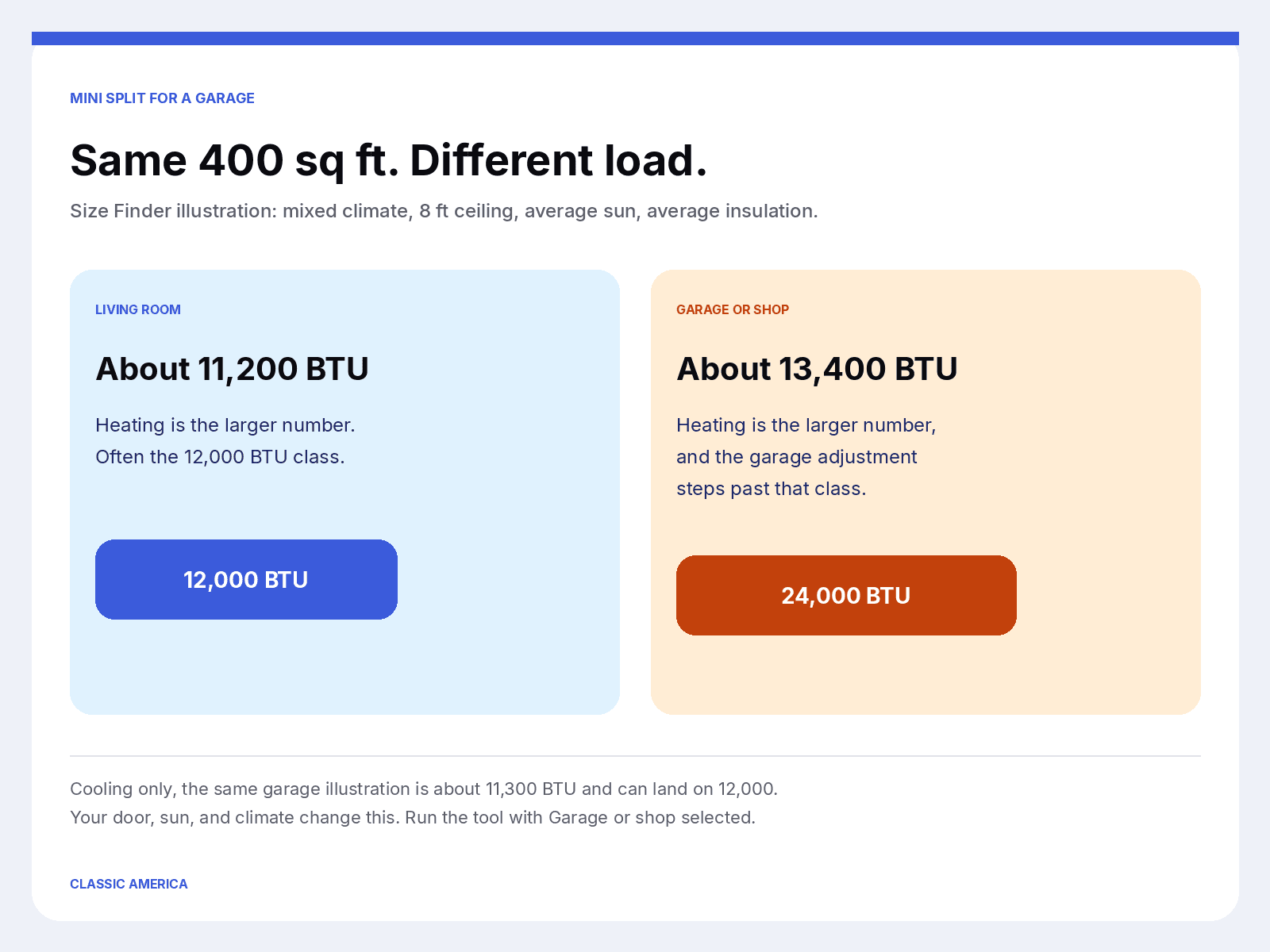
The Size Finder treats “Garage or shop” as its own room type. It adds about 25 percent to the cooling load and uses a higher heating factor, because these spaces are often lightly insulated and the door is a large, leaky surface. That's an allowance, not a measurement of your door. If you've already insulated and air-sealed, say so in the insulation setting. If the door is bare, be honest and don't call the room average.
The picture at the top shows one example: 400 square feet, 8-foot ceiling, average sun, average insulation, mixed climate, cooling and heating. The living room comes out to about 11,200 BTU, and the smallest match is the 19 SEER2 12,000 BTU model (heating nameplate 12,200). The garage comes out to about 13,400 BTU, with heating as the bigger number, and the 12,000 BTU heating nameplate can't cover it. So the tool steps up to the 23,000 BTU system. For cooling only, that same garage is about 11,300 BTU and can land on 12,000. Your climate and your door will change these numbers, so be sure to enter them.
Pick Garage or shop in the free Size Finder. It applies the extra load for a large door and light insulation, then matches a model. The sizing guide explains the same adjustments for an ordinary room.
A garage mini split sizing chart
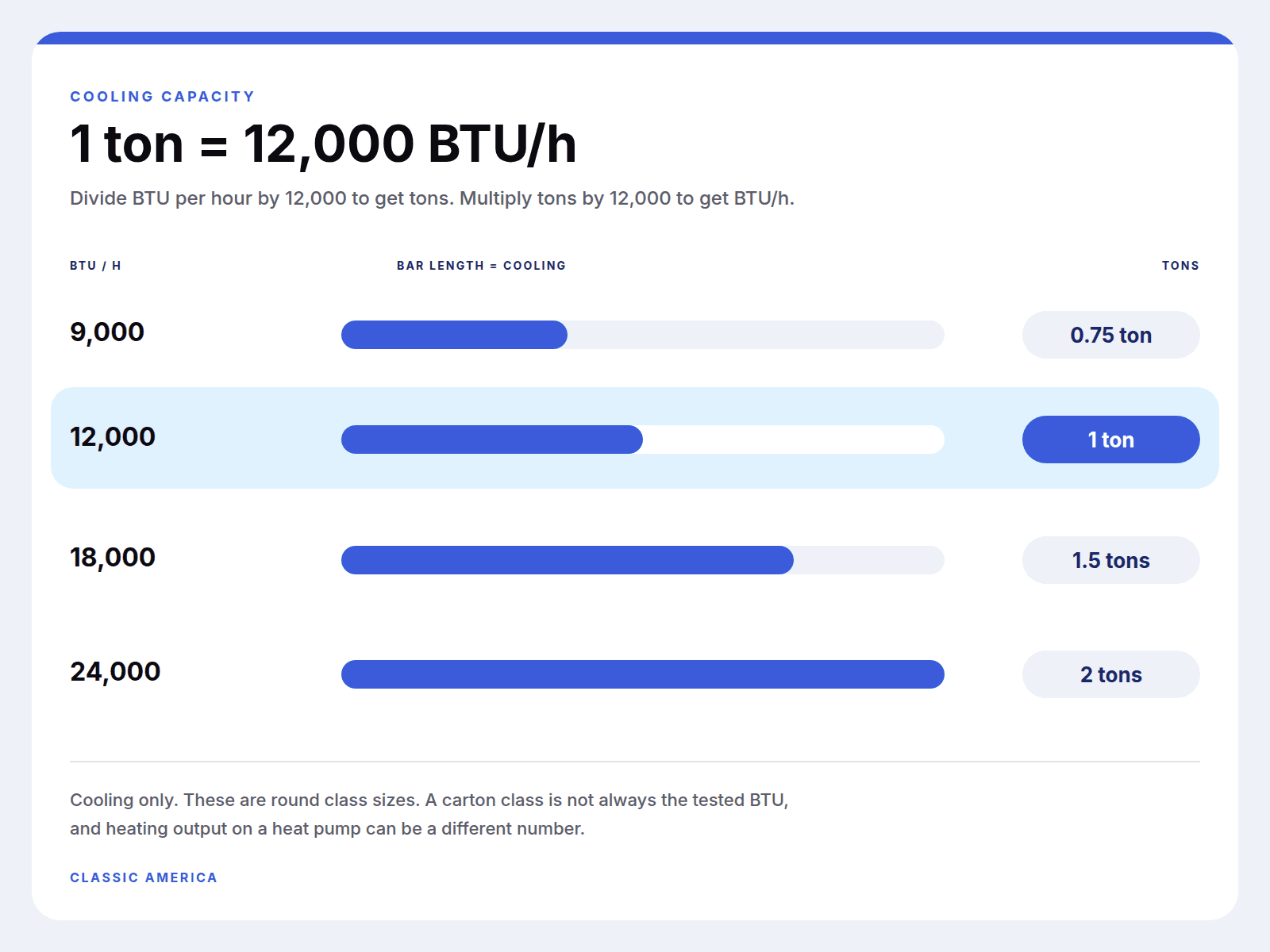
This isn't a second national chart. It's the Size Finder run on a few sample garages, so you can see the pattern before entering your own. The mini split BTU calculator walkthrough explains the inputs, and the mini split sizing guide has the standard-room chart, including why square footage is only the starting point. If someone quoted your garage in tons, the BTU to tons guide can help. One ton of cooling is 12,000 BTU/h.
| Garage you can enter | Estimate | Smallest match here |
|---|---|---|
| 240 sq ft, 8 ft, shaded, good insulation, mixed climate, cooling only | About 6,100 BTU | 9,000 BTU can cover that cooling estimate |
| 400 sq ft, 8 ft, average sun and insulation, mixed climate, cooling only | About 11,300 BTU | 12,000 BTU, 19 SEER2 |
| That same 400 sq ft garage, cooling and heating | About 13,400 BTU. Heating is larger. | 23,000 BTU. The 12,200 heating nameplate does not cover it. |
| 550 sq ft, 8 ft, average sun and insulation, mixed climate, cooling only | About 15,000 BTU | 23,000 BTU. A living room of 550 sq ft starts at 12,000. |
| About 22 by 22 ft, 9 ft, sunny, poor insulation, hot and humid, cooling | About 23,500 BTU | 23,000 BTU, close to the nameplate. Confirm the load if this is the only system. |
| 24 by 24 ft, 10 ft, sunny, poor insulation, mixed climate, heat and cool | About 27,800 BTU | Above the 23,000 BTU cooling nameplate. Insulate, or get a pro load calc. |
Is 12,000 BTU enough for a garage?
Sometimes, yes. A 12,000 BTU mini split is a real match for a garage when the Size Finder lands near that cooling number and you aren't counting on the heating nameplate to handle a colder climate. In the table, the 400 square-foot average garage in a mixed climate is exactly that case if you only cool it. As soon as you add heat, the same example steps up to the 23,000 BTU system.
It's not the go-to for a two-car garage, though. In that mixed-climate example, a 550 square-foot garage at 8 feet, with average sun and average insulation, needs about 15,000 BTU of cooling. A 550 square-foot living room starts at 12,000 BTU on the ENERGY STAR chart. The garage allowance makes up the whole difference. The 19 SEER2 spec sheet’s “up to about 550 square feet” means a typical room, not a bay with a garage door.
Check the class before you grab the less expensive 12,000 BTU box. The 19 SEER2 12,000 BTU mini split delivers 12,000 BTU/h at 19 SEER2, covers up to about 550 square feet in a typical room, and runs on 115V. The 17 SEER2 12,000 BTU mini split publishes 11,500 BTU of cooling and up to about 550 square feet. That's a room range, not a garage range, so it isn't the right choice for a two-car door. And please don't read either model as 600 square feet.
Which model fits a garage
Lots of people search for the best mini split for a garage. The more helpful question is which capacity fits your bay, your climate, and whether you want heat. There's no single best box for everyone.
- A small, shaded, insulated bay that you mostly cool can land on the 9,000 BTU, 23 SEER2, 115V model. Its published coverage is up to about 400 square feet for a typical room, and the garage still needs to check out in the tool.
- A modest bay that the tool puts near 12,000 BTU of cooling, without a heating load beyond the 12,200 nameplate, points to the 19 SEER2 12,000 BTU model.
- A two-car garage, a heating load, or a sunny, poorly insulated door usually points to the 23,000 BTU model: 23,000 BTU/h of cooling, a 22,400 BTU/h heating nameplate, 12,000 BTU/h at 5°F, coverage up to 1,400 square feet, 208/230V, and 17 SEER2.
- DUET pairs two 9,000 BTU heads with an 18,000 BTU outdoor unit, rated 24 SEER2 non-ducted. It's a two-room system, so it's only a garage solution if the garage itself fits a 9,000 BTU head and you have a second room that does too.
From the spec sheet
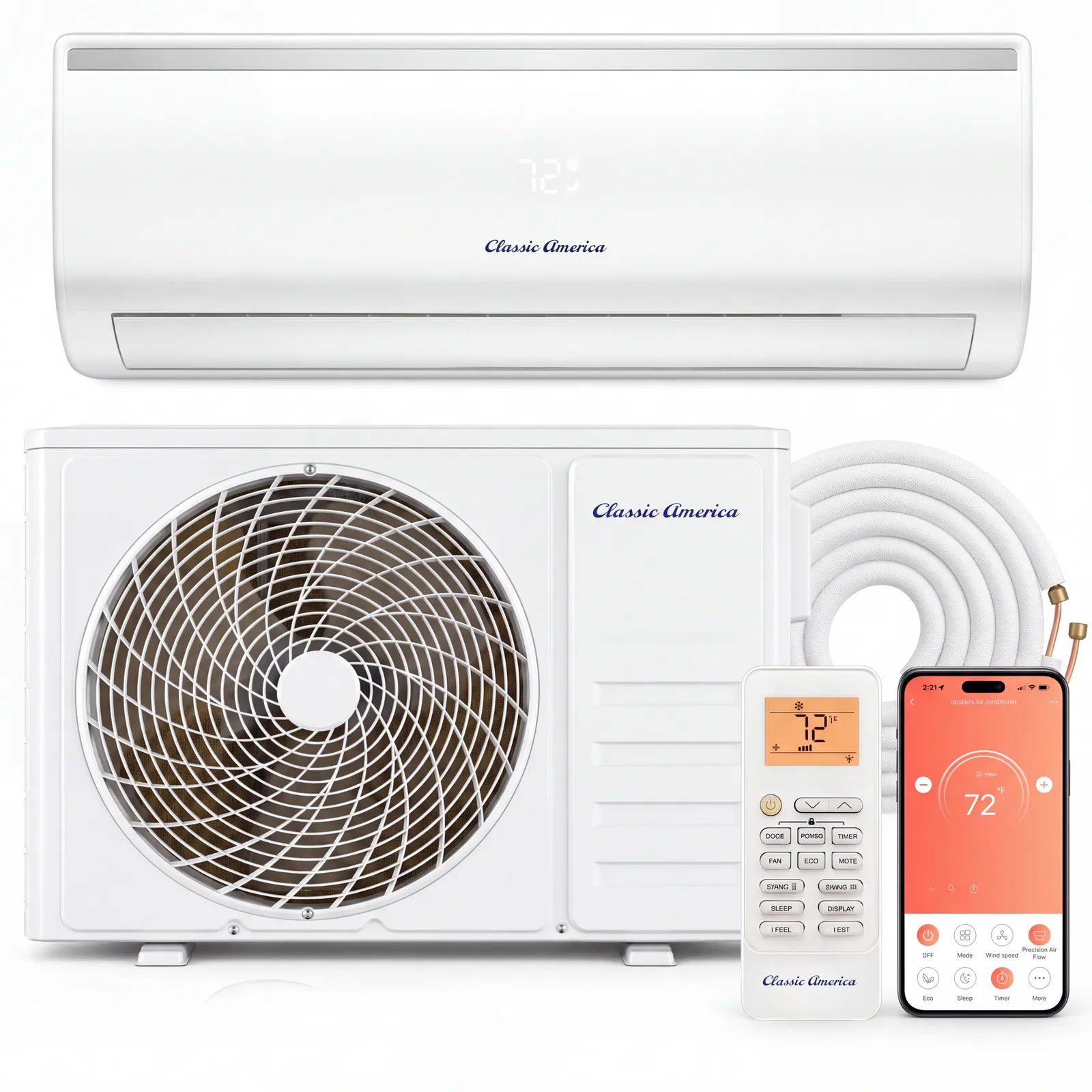
- 9,000 BTU/h cooling · 0.75 ton
- 23 SEER2
- 115V
- Up to 400 sq ft
- Heating nameplate 9,500 BTU/h
From the spec sheet
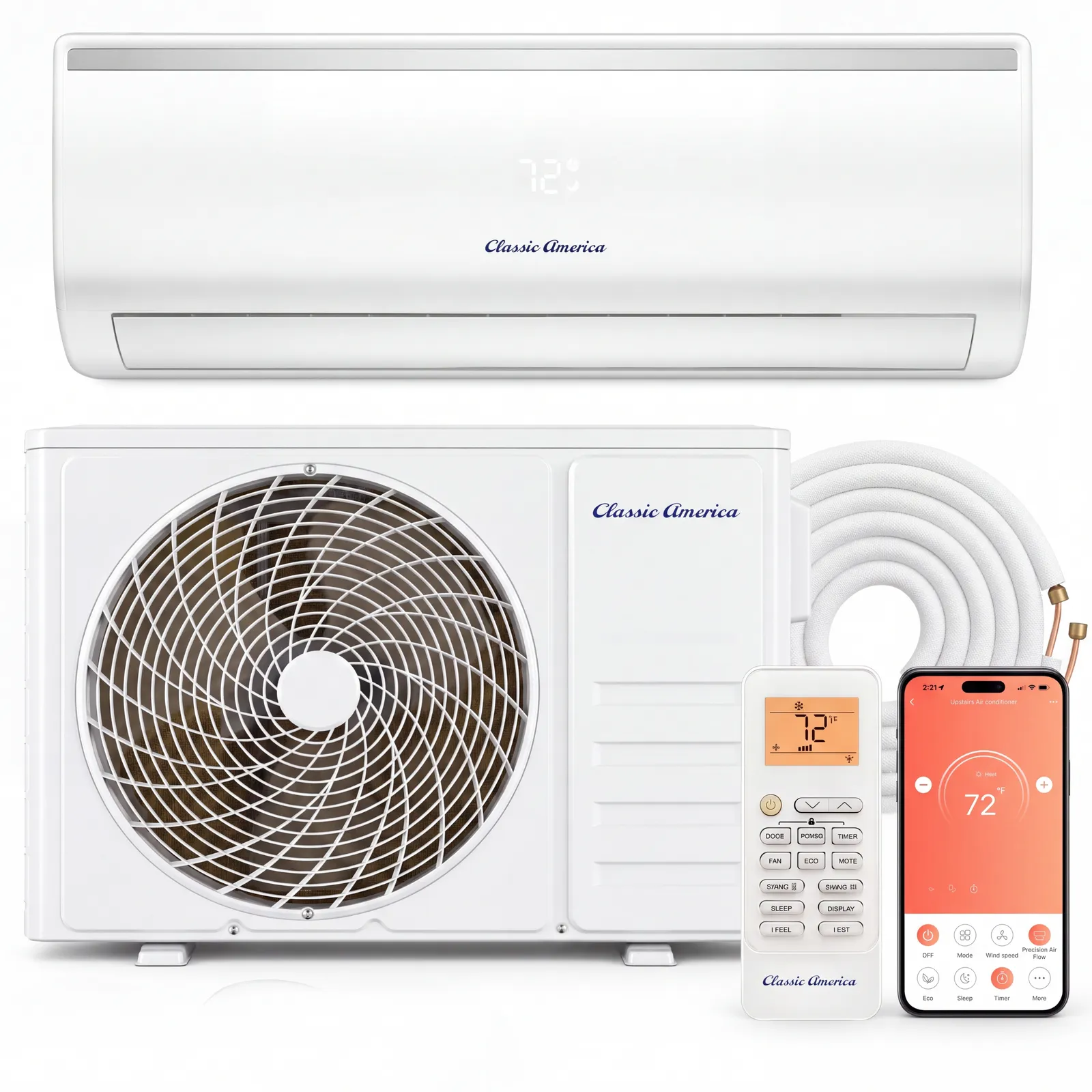
- 12,000 BTU/h cooling · 1 ton
- 19 SEER2
- 115V
- Up to 550 sq ft
- Heating nameplate 12,200 BTU/h
From the spec sheet
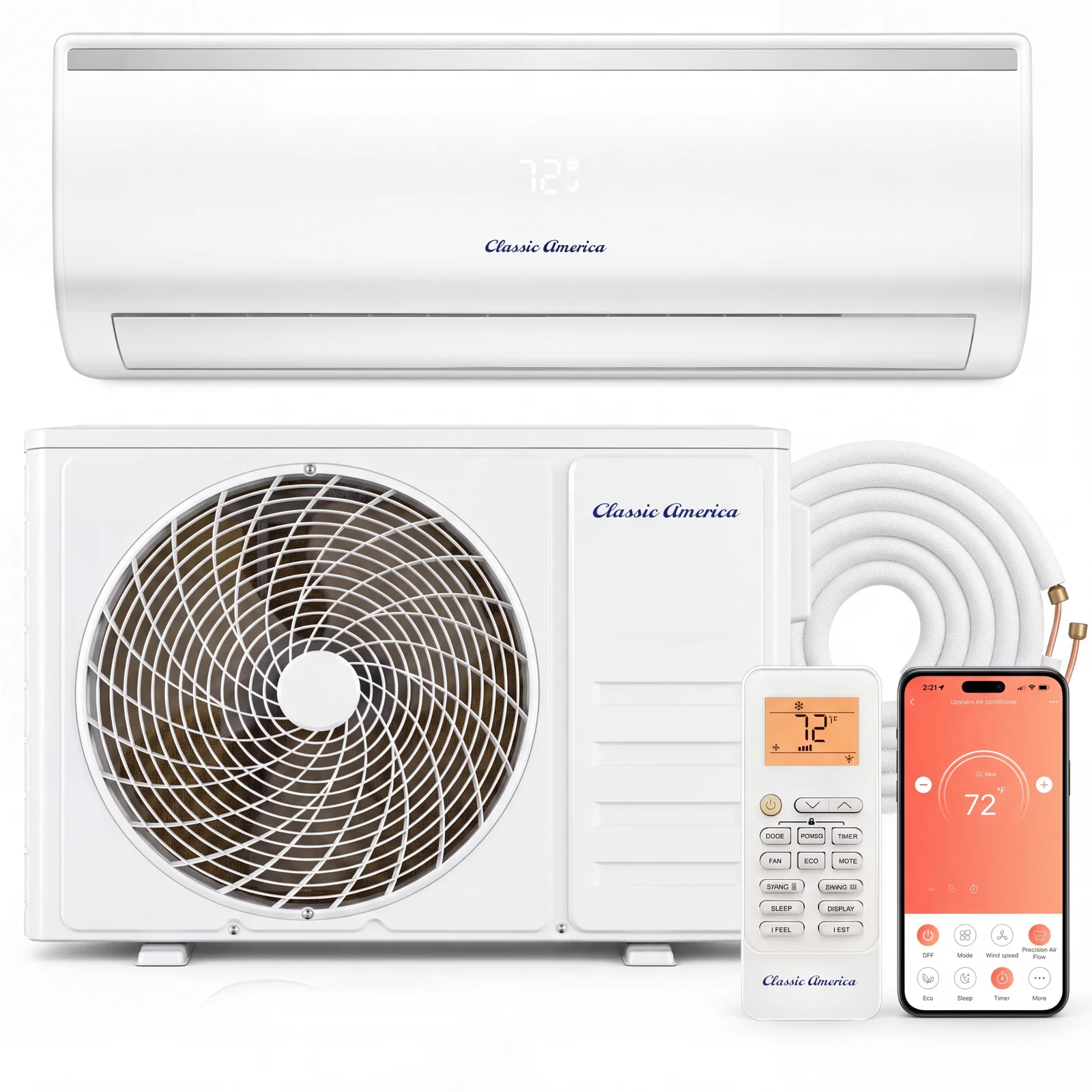
- 23,000 BTU/h cooling · 1.92 tons
- 17 SEER2
- 208/230V
- Up to 1,400 sq ft
- Heating nameplate 22,400 BTU/h
If the estimate climbs past 23,000 BTU of cooling, or past the 22,400 heating nameplate, we don't have a bigger single-zone system to offer you. Insulate and air-seal the door and walls, then run the tool again. If it's still over, have a licensed HVAC professional do a load calculation. Please don't put a second head in one open bay and call it zoned.
Where the head and the outdoor unit go
The indoor head works best on an interior wall where it can blow across the bay, mounted high enough to clear a parked car and a workbench, and ideally not aimed straight at the door. The door is the cold draft in winter and the hot slab of metal in summer. The outdoor unit stays outdoors, on a pad or a wall bracket, with room to breathe. It doesn't belong inside a closed garage, because a closed-in condenser can't get rid of heat.
Plan the line-set hole on a wall you don't mind patching, along with a condensate drain that actually slopes away. In a climate where it freezes, a drain that empties where people walk becomes a slip hazard, not just a detail. None of that is refrigerant work. The install planner checks line-set length and mounting against your model, and the delivery and installation guide shows what's in the box.
115V or 230V in a garage
Many garages have a convenience outlet and not much else, and that outlet isn't a dedicated mini split circuit. Our 9,000 and 12,000 BTU single-zone systems are 115V, so even if the tool matches one of those, you still need to confirm a circuit rather than plug in next to the shop light. The 23,000 BTU system needs 208/230V, so if heating bumps your match up to the 23,000 BTU system, that's a panel question too.
We don't list wire sizes or guess at breakers here; a licensed electrician confirms the circuit. Our upcoming 110V mini split guide covers voltage, and the 110V mini split hub lists the 115V models. If you're weighing one garage head against a second room in the house, check out the dual zone mini split guide (and skip the longer extension cord).
Insulation changes the BTU you need
As the last row of the table shows, a bare door can call for more capacity than a 23,000 BTU nameplate can honestly deliver. Insulation and weatherstripping are often the less expensive fix, and they help whatever you buy run less. They don't replace sizing, though. An insulated garage is a milder garage, but it's still a garage. Set the insulation input to match what you actually did, then check the new BTU.
If you only use the garage now and then, that's a point in favor of a mini split. You can heat or cool the bay while you're in it and let it rest when the cars are the only ones there. An inverter can slow down instead of just slamming on and off, which helps in a shop that's full of people one hour and empty the next. It still can't make up for a big miss on capacity.
Garage numbers that get stretched
- Please don't apply the 19 SEER2 “up to about 550 square feet” note to a garage. That figure is for a typical room. The 550 square-foot garage example above needs about 15,000 BTU of cooling.
- The 17 SEER2 model is 11,500 BTU and covers up to about 550 square feet. That isn't a two-car bay.
- DUET is 24 SEER2 non-ducted, across two 9,000 BTU heads. It isn't one 1.5-ton garage head, and it isn't 24.5.
- The 23,000 BTU spec sheet is rated 17 SEER2. Its heating nameplate is 22,400 BTU/h, which isn't a guarantee at 5°F.
What you can plan, and what a pro does
Mounting versus commissioning
- Planning the mounting wall, where the outdoor unit will sit, and the path of the line set is great homeowner work. Many owners handle the mounting and the hole themselves.
- Refrigerant connections, pulling a vacuum, and a dedicated electrical circuit are jobs for a licensed HVAC professional.
- These systems come with a 5-year compressor warranty and 1 year on parts.
Equipment price and install price have their own articles. Our guide to how much a mini split costs covers the equipment, using commonly published US ranges rather than Classic America prices. Labor, the circuit, and the permit are covered in the upcoming mini split installation cost guide. For sheds and bonus rooms without the garage-door problem, see sheds, bonus rooms, and other nonstandard spaces.
Pick Garage or shop in the Size Finder, then check the matched card against the spec sheet. If you're deciding between 12,000 and 24,000, compare models side by side in the compare tool. Prefer to talk it through? Call us at 1-800-349-4360 Ext. 204, Monday through Friday, 10 AM to 3 PM ET.
FAQ
Common questions
What size mini split do I need for a garage?
Size it for the garage, not for a living room with the same floor area. In the Size Finder, pick Garage or shop. A small insulated bay can land on 9,000 or 12,000 BTU, while a two-car garage, especially with heat, often lands on the 23,000 BTU system. The rows in this guide are examples, so enter your own door, sun, and climate.
Is a 12,000 BTU mini split enough for a two-car garage?
Not usually. A 400 square-foot average garage in a mixed climate needs about 11,300 BTU if you only cool it, which can match the 19 SEER2 12,000 BTU model. Add heating, and that same example needs about 13,400 BTU, which steps up to the 23,000 BTU system. A 550 square-foot garage example needs about 15,000 BTU of cooling. The “up to about 550 square feet” note is for a typical room.
Can a mini split heat a garage?
Our single-zone models are heat pumps, so they heat as well as cool. Heating output isn't a copy of the cooling BTU, though, and it drops as it gets colder outside. The 23,000 BTU model’s heating nameplate is 22,400 BTU/h, which isn't a guarantee at 5°F. If the mini split will be your only heat, have a licensed HVAC professional confirm the load.
Do I need 230V for a garage mini split?
If your match is the 23,000 BTU model, yes, since that system is 208/230V. Our 9,000 and 12,000 BTU single-zone systems are 115V. Keep in mind that a garage outlet you use for tools isn't automatically a dedicated circuit. A licensed electrician confirms the circuit, so we don't list wire sizes here.
Can I install a garage mini split myself?
You can plan the indoor head, the outdoor location, and the line-set path, and many owners do the mounting themselves. Refrigerant connections, pulling a vacuum, and a dedicated electrical circuit are jobs for a licensed HVAC professional. The outdoor unit stays outside. You're covered for 5 years on the compressor and 1 year on parts.
Should I insulate the garage before I buy?
If the door and walls are bare, insulation and air sealing can change the BTU more than stepping up a size, and a large uninsulated bay can need more than the 23,000 BTU nameplate. Insulate first, then run the Size Finder again. An insulated garage is still a garage, so please don't size it from a living-room chart.
The lineup
Models in this article
From the spec sheet
- 23,000 BTU/h cooling · 1.92 tons
- 17 SEER2
- 208/230V
- Up to 1,400 sq ft
- Heating nameplate 22,400 BTU/h