BTU to Tons: How Many BTU Are in a Ton of Cooling?
James S. · Sep 26th 2026
One ton of air-conditioning capacity is 12,000 BTU per hour. Use that rule to translate a contractor quote or a carton label, then match a mini split or window AC to the room you actually have.
The short answer
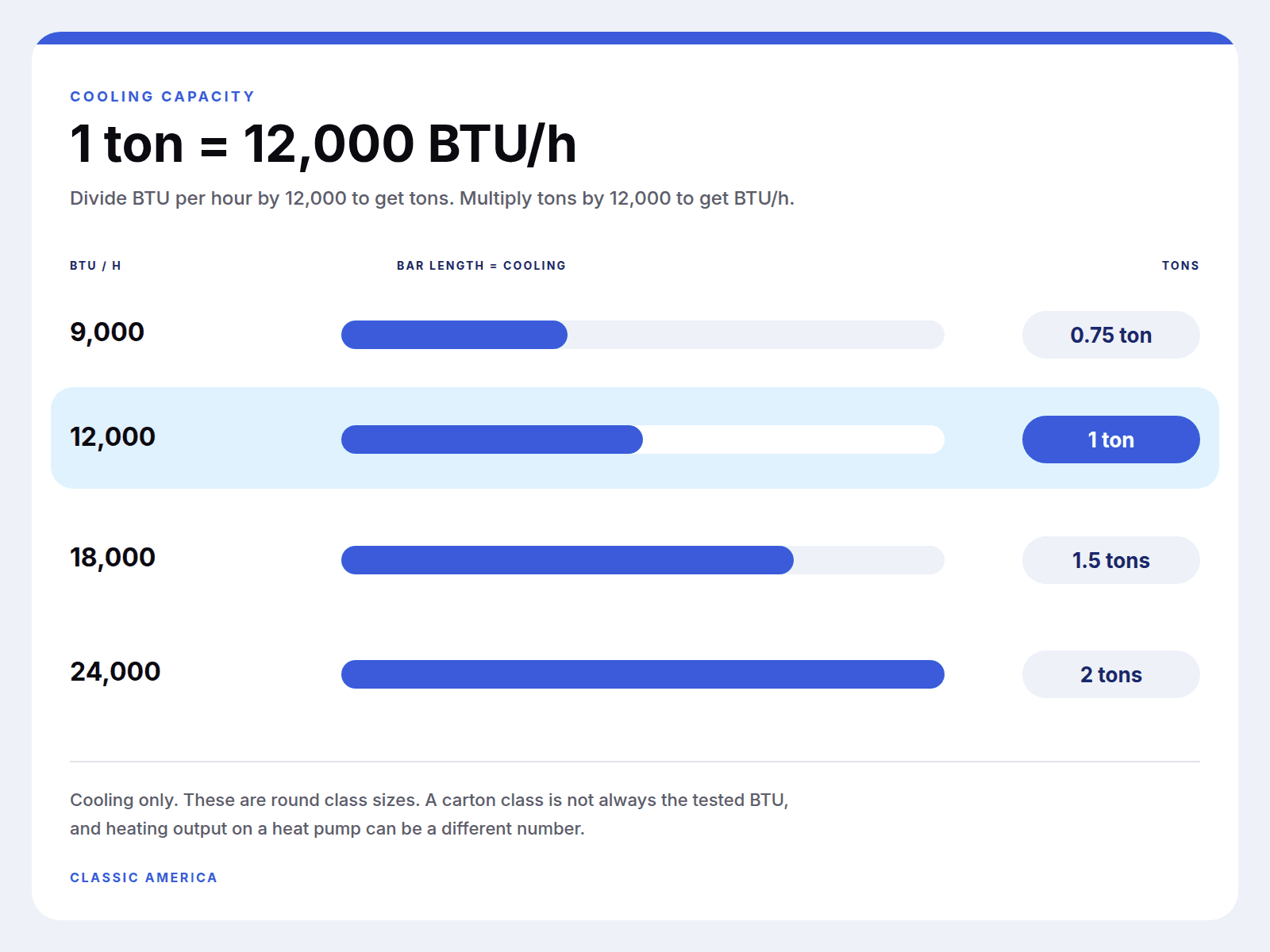
- 1 ton of cooling = 12,000 BTU per hour. Divide BTU/h by 12,000 to get tons, or multiply tons by 12,000 to get BTU/h.
- 9,000 BTU/h is 0.75 ton. 12,000 is 1 ton. 18,000 is 1.5 tons. 24,000 is 2 tons.
- The 19 SEER2 model at 12,000 BTU/h is published for up to about 550 square feet. The 17 SEER2 model in that class publishes 11,500 BTU of cooling.
- DUET is 18,000 BTU across two indoor heads, rated 24 SEER2 (non-ducted ENERGY STAR). It is not one 1.5-ton head.
- Square footage is a clue. The Size Finder adjusts for sun, ceiling height, insulation, and climate.
How many BTU are in a ton?
In air conditioning, a ton is a rate of cooling, not the weight of the outdoor unit. One ton of cooling capacity equals 12,000 BTU per hour (BTU/h). BTU stands for British thermal unit. The “per hour” matters. A BTU by itself is a small quantity of heat. The number printed for an air conditioner is how much heat the equipment can remove each hour while it is cooling.
A contractor may say you need “a ton and a half.” A product page may say “12,000 BTU.” Those are two labels for the same idea. To convert tons to BTU/h, multiply by 12,000. To convert BTU/h to tons, divide by 12,000. A quote for 1.5 tons is 18,000 BTU/h of cooling. A carton marked 24,000 BTU is 2 tons of cooling capacity.
- Start with the number you were given, either in tons or in BTU per hour.
- If you have tons, multiply by 12,000 to get BTU/h.
- If you have BTU/h, divide by 12,000 to get tons.
- Treat that result as cooling capacity, then check it against the room before you buy.
| BTU/h (cooling) | Tons | In this lineup |
|---|---|---|
| 8,000 | 2/3 | Window AC · 115V · cooling only |
| 9,000 | 0.75 | Mini split · 23 SEER2 · 115V · up to 400 sq ft |
| 11,500 | Just under 1 | 17 SEER2 model in the 12,000 BTU class · 115V · up to 280 sq ft |
| 12,000 | 1 | 19 SEER2 mini split · 115V · up to 550 sq ft |
| 18,000 | 1.5 | DUET · two 9,000 BTU heads · 24 SEER2 non-ducted · 208/230V |
| 23,000 | 1.9 (2 ton class) | Single-zone mini split · 208/230V · up to 1,200 sq ft · 17 SEER2 |
An 8,000 BTU window unit is two-thirds of a ton (8,000 ÷ 12,000). Anything in between works the same way. The 11,500 BTU row is the one that surprises people: that model is sold in the 12,000 BTU class, and the spec sheet publishes a tested cooling capacity just under a full ton. The arithmetic is the easy part. Rooms are not round numbers, which is why the label is a starting point.
Why the box says BTU and the quote says tons
Central air has been sold in tons for a long time, so many contractors still talk that way: “you need two tons.” Mini splits and window air conditioners are sold to homeowners in BTU, because that is the figure in the model name and on the carton. Neither label is more official. They describe the same cooling capacity.
When tons mislead
- The ton conversion is for cooling. On a heat pump, heating capacity can be a different number, and it falls when it is cold outside.
- The 17 SEER2 model is sold in the 12,000 BTU class. The spec sheet publishes 11,500 BTU of cooling, just under a full ton.
- DUET’s 18,000 BTU (1.5 tons) is one outdoor unit and two indoor heads, not one head for a single 1.5-ton room. The non-ducted ENERGY STAR rating is 24 SEER2.
- The 2 ton class system publishes 23,000 BTU of cooling, just under 2 full tons (about 1.9).
Window units use the same BTU scale and almost never say “tons.” A 12,000 BTU window air conditioner is one ton of cooling on the label, and it is still not the same product as a 12,000 BTU mini split. One plugs into a window. The other is a ductless heat pump. An inverter mini split also does not run flat-out all afternoon. The BTU rating is what it can deliver, not what it uses every hour.
Common sizes, and when each one tends to fit
Square footage is a clue, not a guarantee. Sun, ceiling height, insulation, and climate all move the load. The notes below follow the capacities Classic America actually publishes. For a room-specific number, use the free Size Finder. It starts from the ENERGY STAR room chart for a typical ceiling and average sun, then adjusts for the room you describe, including winter heating.
9,000 BTU is about 0.75 ton
A 9,000 BTU mini split is the small-room size: a bedroom, a home office, a studio. Classic America’s 9,000 BTU mini split is a 23 SEER2 heat pump on 115V, published for up to about 400 square feet under typical conditions, with 9,000 BTU/h of cooling. If the Size Finder lands well above that, step up. The 9,000 BTU hub collects the model in one place.
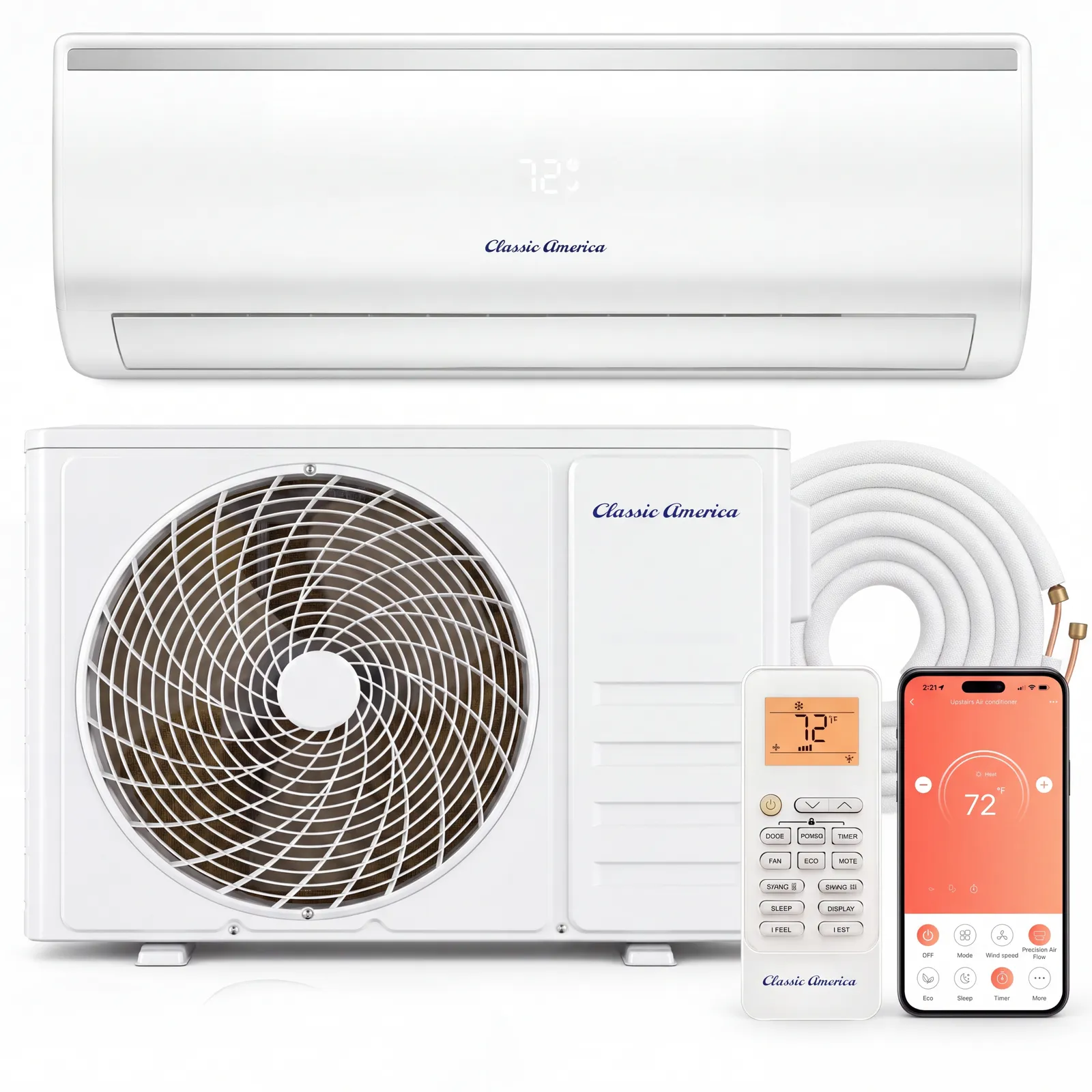
From the spec sheet
- 9,000 BTU/h cooling · 0.75 ton
- 23 SEER2
- 115V
- Up to 400 sq ft
- Heating nameplate 9,500 BTU/h
12,000 BTU is 1 ton
This is the size people mean by “a one-ton mini split.” Twelve thousand BTU/h divided by 12,000 is exactly one ton. Classic America lists two single-zone systems in this class, both on 115V, on the 12,000 BTU hub.
- The 19 SEER2 model is rated 12,000 BTU/h cooling and up to about 550 square feet under typical conditions.
- The 17 SEER2 model publishes 11,500 BTU/h cooling and coverage up to about 280 square feet. Pick it when the room load and the budget point that way, not only because the name says 12,000.
Both are heat pumps. Compare the 19 SEER2 12,000 BTU mini split and the 17 SEER2 12,000 BTU mini split side by side, or let the Size Finder break a tie between 9,000 and 12,000. A kitchen, a west-facing wall of glass, or a tall ceiling is enough to move the answer. The card below is the 19 SEER2 model, the one rated a full 12,000 BTU/h.
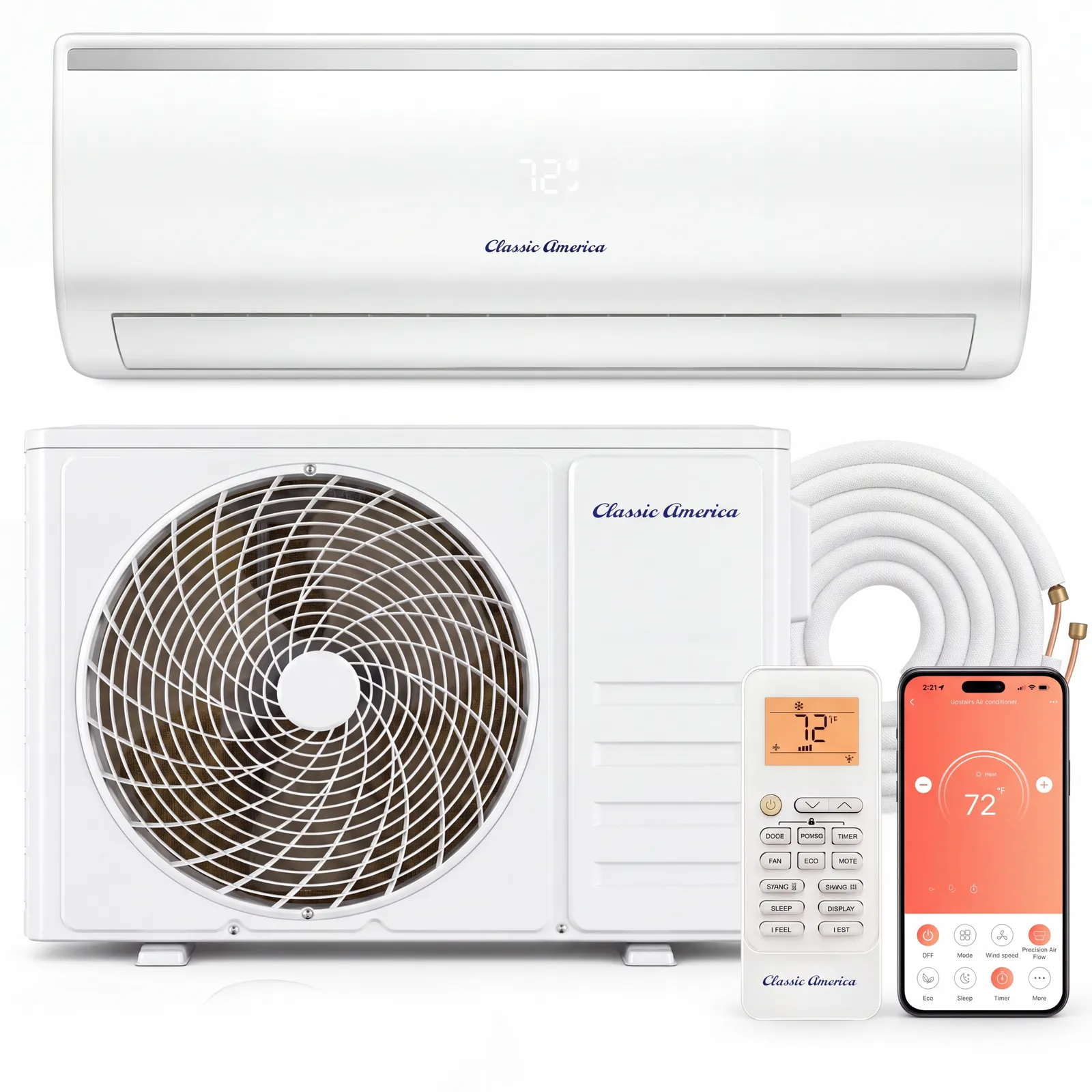
From the spec sheet
- 12,000 BTU/h cooling · 1 ton
- 19 SEER2
- 115V
- Up to 550 sq ft
- Heating nameplate 12,200 BTU/h
18,000 BTU is 1.5 tons
Eighteen thousand BTU/h is 1.5 tons of cooling. In this lineup that capacity is the DUET: one outdoor unit rated 18,000 BTU cooling, with two indoor heads at 9,000 BTU each. It is not one head for a single 1.5-ton room. Each head should fit its own room. DUET is rated 24 SEER2 (non-ducted ENERGY STAR) on 208/230V. We do not publish one square-footage number for the pair, because two rooms rarely share a load — add both in the Size Finder. The dual-zone hub is where to read the system on its own.
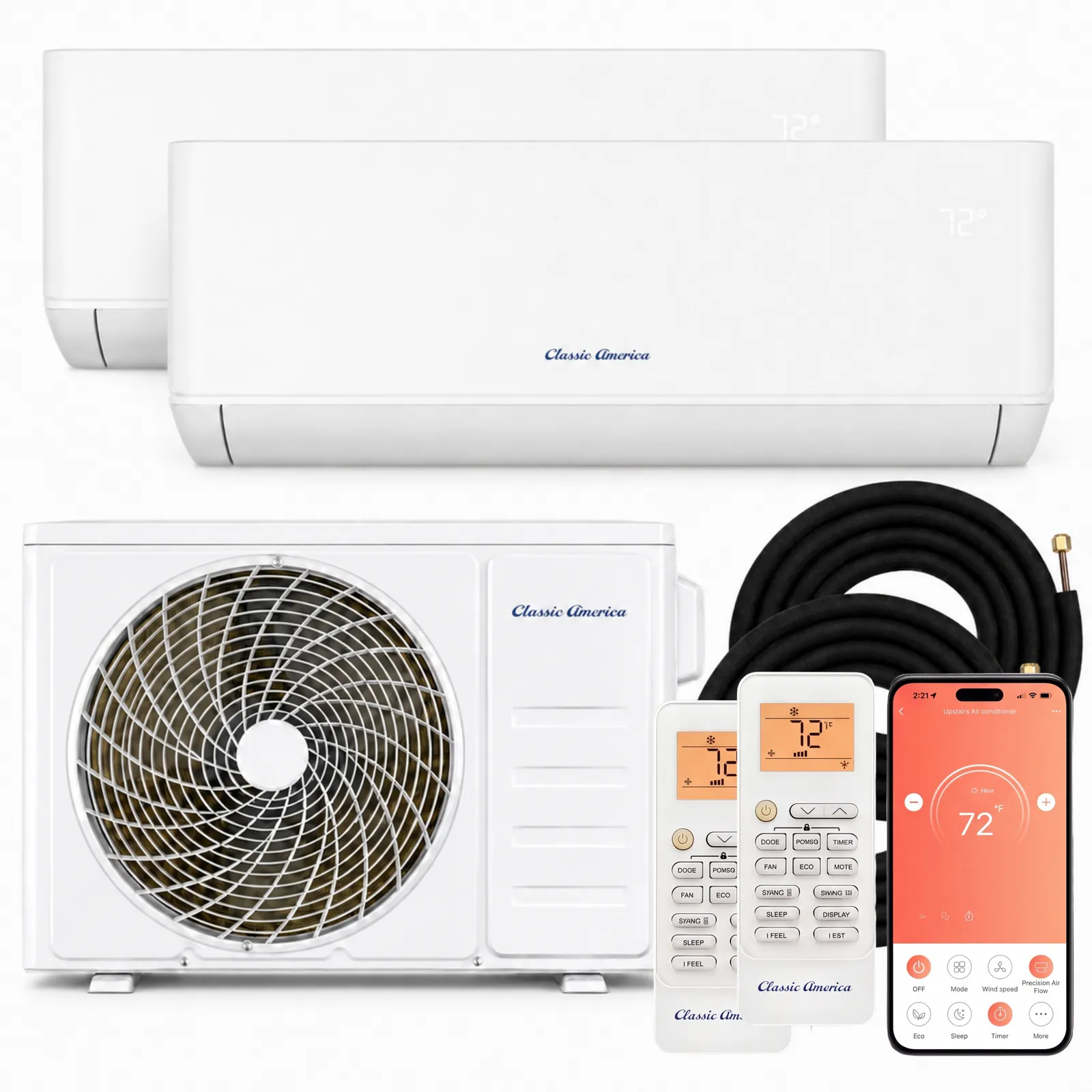
From the spec sheet
- 18,000 BTU/h cooling · 1.5 tons
- 24 SEER2, non-ducted ENERGY STAR
- 208/230V
- Two 9,000 BTU indoor heads on one outdoor unit
- Heating nameplate 20,000 BTU/h
23,000 BTU is the 2 ton class
Twenty-four thousand BTU/h is exactly 2 tons of cooling. Classic America's 2 ton class system, the 23,000 BTU mini split (model MSCR32-23CHSA2), is rated at 23,000 BTU/h, about 1.9 tons. It is the large single-zone heat pump for open living areas and additions, rated 17 SEER2 for spaces of up to 1,200 square feet under typical conditions, and it uses 208/230V rather than the 115V of the smaller single-zone systems. If the Size Finder puts the room at 12,000 BTU or below, a smaller 115V system is the closer match. Two separate rooms point to DUET, not one head trying to reach around a corner. The 2 ton mini split hub collects the model and its ratings.
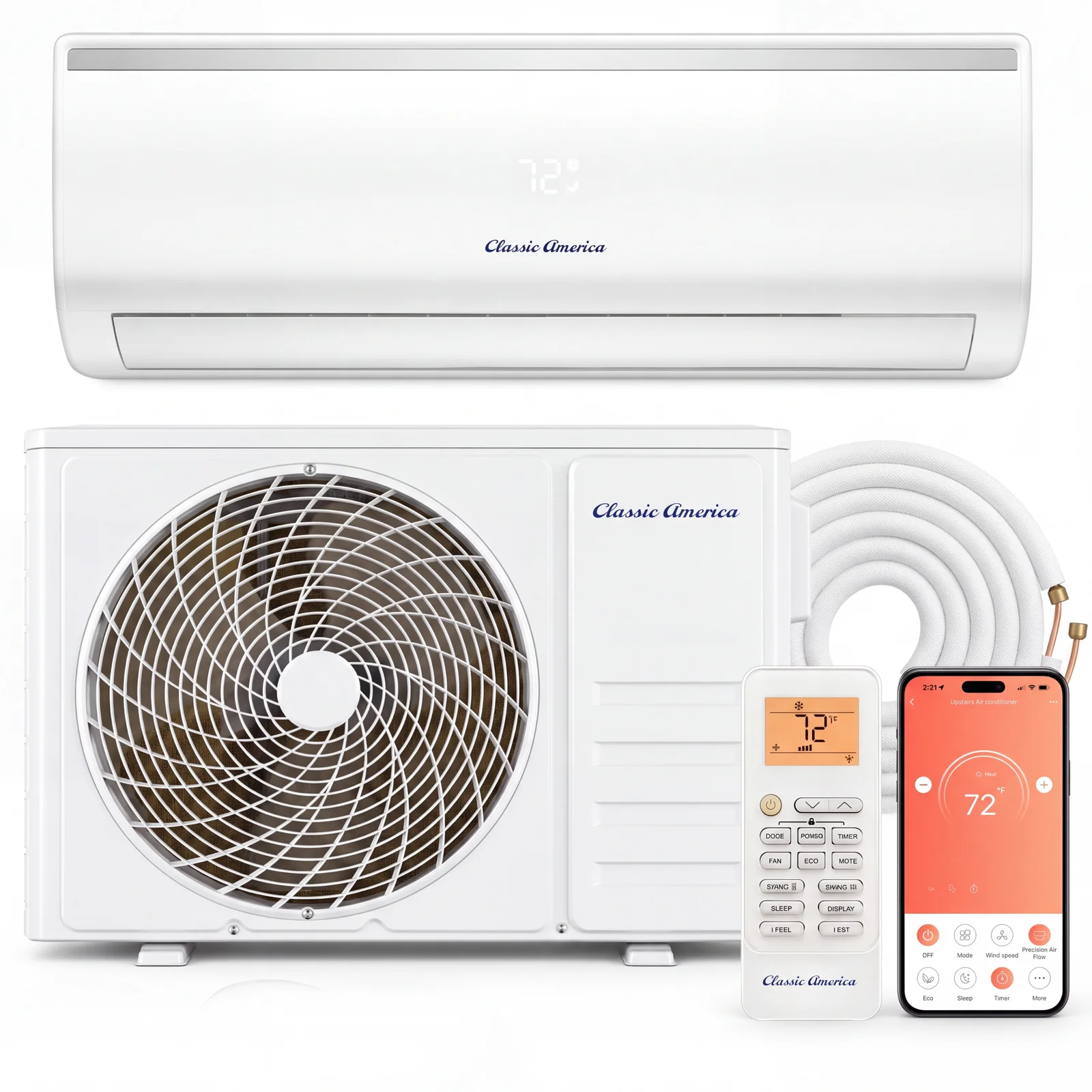
From the spec sheet
- 23,000 BTU/h cooling · 1.92 tons
- 17 SEER2
- 208/230V
- Up to 1,200 sq ft
- Heating nameplate 22,400 BTU/h
Window air conditioners use the same math
Window units are shopped in BTU and by the window opening. Classic America offers an 8,000 BTU window air conditioner and a 12,000 BTU window air conditioner. Both are 115V plug-in units, and neither provides heat. Matching BTU does not make a window unit and a mini split interchangeable. Browse the window AC category, and confirm the opening with the Window Fit Checker.
The conversion is the label. The room is the rest. The free Size Finder turns sun, ceiling height, insulation, and climate into a BTU number and a matched model. Then browse mini splits — 9,000, 12,000, 24,000 BTU / 2 ton, or DUET.
What goes wrong if the size is off
Getting the conversion right and then buying the wrong size still leaves the room uncomfortable. Undersized equipment runs a long time and may never reach the setpoint on the hottest afternoon, or on a cold morning if you are heating with a heat pump. Mild days feel fine. Extreme days fall behind.
Oversized equipment can short-cycle: it satisfies the thermostat quickly, shuts off, and starts again. Cooling that stops and starts spends less time pulling moisture out of the air, so the room can feel cool and damp. Inverter systems can slow down instead of only switching fully on or fully off, which softens a modest mismatch. A large mismatch still shows up. A bigger number is not automatically more comfortable.
A single square-foot rule misses the things that move the load. The Size Finder is built around those adjustments:
- Direct sun, especially glass that faces west or south
- Ceilings taller than a typical 8 feet
- Insulation and leaks, including a garage door or a room over an unconditioned space
- Kitchens, and rooms where several people spend time
- Climate, because a hot afternoon and a cold night are different loads
If you want the longer explanation of humidity and sizing, the piece on why mini split sizing affects humidity walks through clammy rooms in more detail. For garages, sheds, and bonus rooms, start with mini splits for nonstandard spaces and still run the calculator. Those rooms rarely match a living-room chart.
Heating capacity is not a copy of the cooling BTU
Most mini splits here are heat pumps. They cool in summer and heat in winter. The cooling BTU you converted into tons is not automatically the heat you get on a cold night. At mild outdoor temperatures, published heating capacity is often close to cooling, and sometimes a bit higher: 9,500 BTU/h of heating on the 9,000 BTU system, 12,200 BTU/h on the 19 SEER2 12,000 BTU system, 20,000 BTU/h on DUET next to 18,000 BTU/h of cooling, and 22,400 BTU/h on the 23,000 BTU system, where heating comes in a little under cooling. Those are nameplate differences, not a cold-weather promise.
As it gets colder outside, heating output falls, because there is less heat outdoors to move. The 9,000 BTU sheet lists 9,500 BTU/h of heating at 47°F, 8,000 at 19°F, and 7,000 at 5°F. The Size Finder estimates heating load as well as cooling and checks it against the published heating capacity. If the mini split will be the main heat, have a licensed HVAC professional confirm the load. The mini split heat pump hub gathers those systems. Window units in this catalog are cooling-only. A larger window unit is not a ton of heat.
What to plan before you buy
What you can plan, and what a pro does
- Planning the mounting wall, where the outdoor unit will sit, and the path of the line set is useful homeowner work.
- Refrigerant connections, pulling a vacuum, and a dedicated electrical circuit are for a licensed HVAC professional.
- Warranty on these systems is 5 years on the compressor and 1 year on parts.
The delivery and installation guide and the install planner describe what ships in the box.
Voltage follows capacity more than it follows the word “ton.” The 9,000 and 12,000 BTU single-zone systems are 115V (the class often called 110V). The 23,000 BTU system and DUET are 208/230V. Confirm the circuit with a licensed electrician. The 110V mini split hub gathers the 115V models if that constraint comes before the tonnage.
Turn the tons into a room
Multiply tons by 12,000 to get BTU/h, or divide BTU/h by 12,000 to get tons. Then run the Size Finder with the real room — sun, ceiling, insulation, and climate — and let it match a model. Browse mini splits by capacity, line up specs in the compare tool, or start from window AC if a window unit is the better fit. The buying guides cover mini split versus window AC once the size is settled. Questions about a specific model: 1-800-349-4360 Ext. 204, Monday through Friday, 10 AM to 3 PM ET.
FAQ
Common questions
How many BTU are in a ton of air conditioning?
One ton of cooling equals 12,000 BTU per hour. Multiply tons by 12,000 to get BTU/h, or divide BTU/h by 12,000 to get tons. A ton here is a rate of heat removal, not the weight of the equipment.
Is 12,000 BTU always exactly one ton?
On the label, 12,000 BTU/h is exactly one ton. A model sold in the 12,000 BTU class can publish a tested cooling capacity that is slightly different. Classic America’s 17 SEER2 system is in that class and the spec sheet lists 11,500 BTU of cooling, just under a full ton. The 19 SEER2 system in the same class is rated 12,000 BTU/h and up to about 550 square feet.
Is a 1.5-ton mini split one indoor head?
Not in this lineup. 18,000 BTU/h is 1.5 tons of cooling, and that capacity is the DUET: one outdoor unit and two 9,000 BTU indoor heads. It is rated 24 SEER2 (non-ducted ENERGY STAR). Size each room on its own in the Size Finder.
Do window air conditioners use tons?
They use the same BTU scale and almost never say “tons.” An 8,000 BTU window unit is two-thirds of a ton. A 12,000 BTU window air conditioner is one ton of cooling on the label. Matching BTU does not make it interchangeable with a mini split: these window units are 115V, cooling-only, and have to fit the opening. Check that opening with the Window Fit Checker.
Is Classic America's 2 ton mini split exactly 2 tons?
Close to it. The 23,000 BTU mini split is rated at 23,000 BTU/h of cooling, about 1.9 tons, and is sold as the 2 ton class. It is rated 17 SEER2, covers up to 1,200 square feet under typical conditions, and runs on 208/230V.
Can I install a mini split myself?
You can plan the mounting wall, the outdoor-unit location, and the line-set path. Refrigerant connections, pulling a vacuum, and a dedicated electrical circuit belong to a licensed HVAC professional. Warranty on these systems is 5 years on the compressor and 1 year on parts.