How-to
Mini Split Sizing: Chart, Square Feet, and What Changes the Answer
Classic AmericaOct 12th 202611 min read
The short answer
- Mini split sizing is about the room's load, not just a square-foot label. Start with capacity, then adjust for your room.
- In our lineup, 9,000 BTU/h is published for up to about 450 sq ft (23 SEER2, 115V). The 19 SEER2 model at 12,000 BTU/h covers up to about 550 sq ft. The 17 SEER2 model in that same class publishes 11,500 BTU and up to about 550 sq ft.
- DUET is 18,000 BTU shared across two indoor heads, rated 24 SEER2 (non-ducted). It isn't one head for a 1.5-ton room.
- The 23,000 BTU model lists coverage up to 1,400 sq ft on 208/230V. It's rated 17 SEER2, about 1.9 tons.
- The chart gives you a starting point. Our free Size Finder factors in sun, ceiling height, insulation, and climate, and the BTU calculator walkthrough shows you how to use it.
Mini split sizing chart
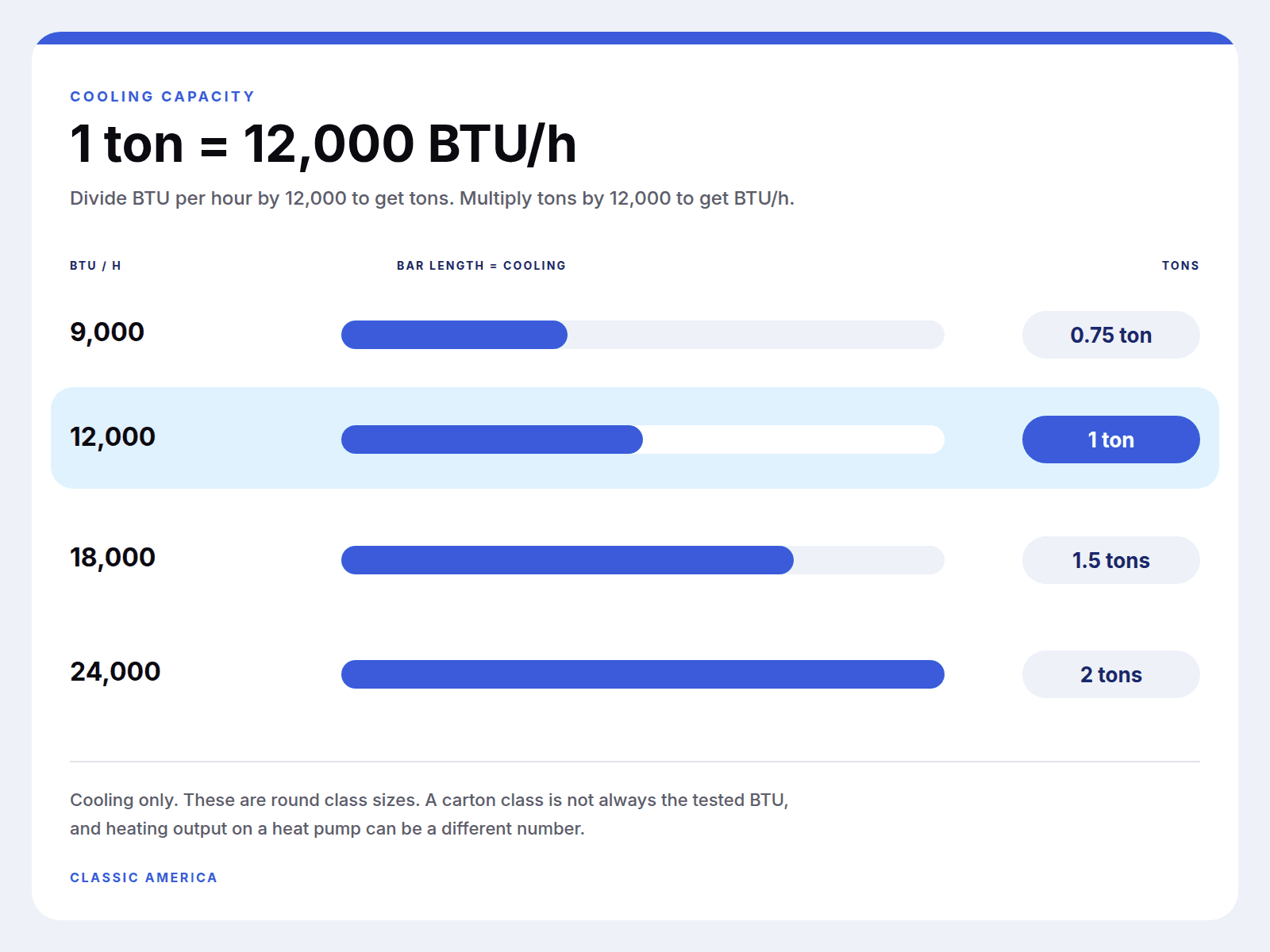
A mini split sizing chart answers a shopping question: which capacity classes are even in the running? It can't tell you which unit belongs in your room. Contractors often talk in tons, while boxes are labeled in BTU per hour. One ton of cooling is 12,000 BTU/h. If your quote came in tons, our BTU to tons guide handles the conversion. This page focuses on your room.
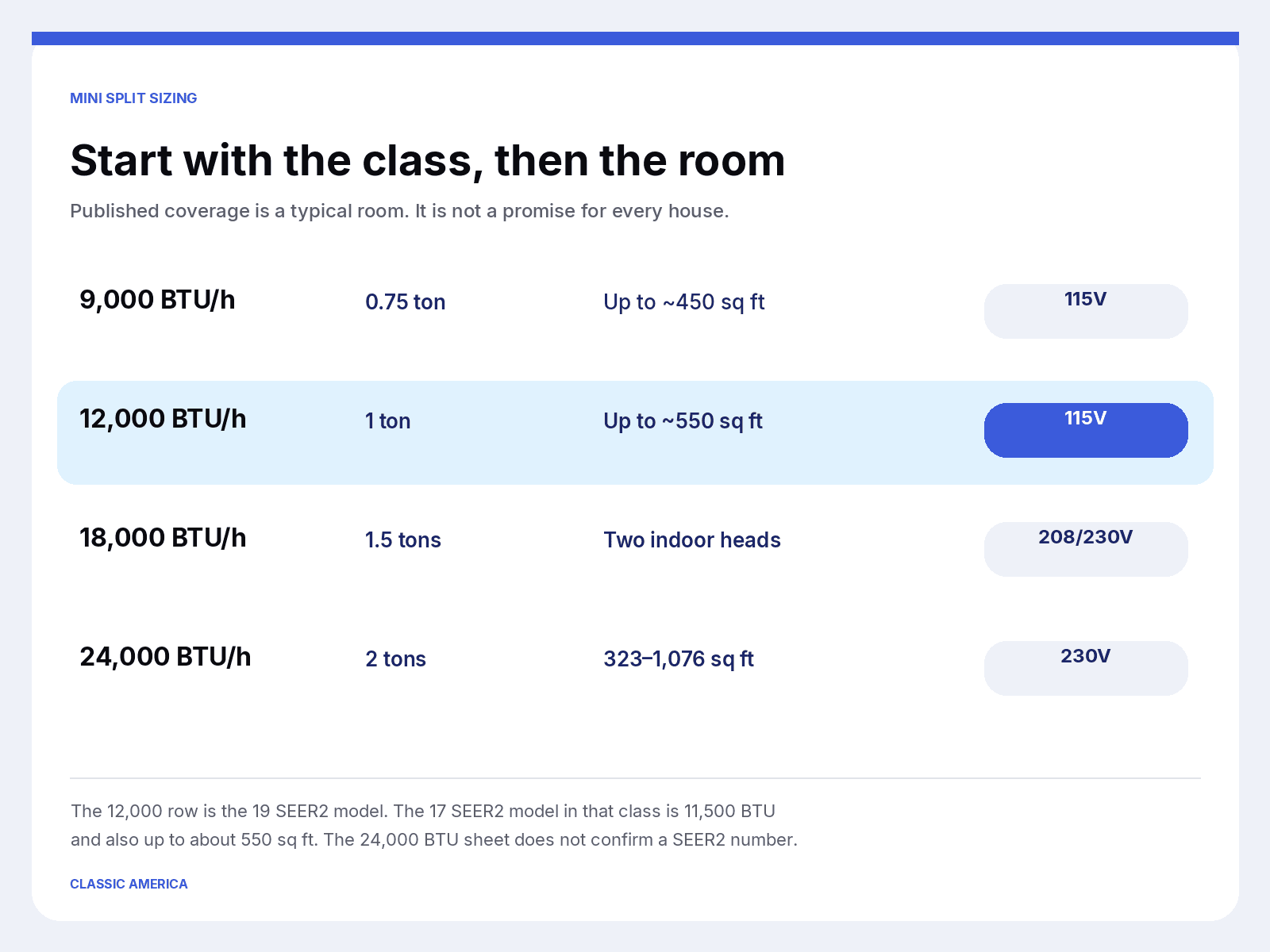
The rows below are the capacities Classic America publishes. “Typical coverage” means the conditions listed on that model’s spec sheet, not every home with the same floor area. If two numbers don't agree, trust the spec sheet and the Size Finder over a rule of thumb from a forum.
| Cooling BTU/h | Tons | Typical coverage | Power |
|---|---|---|---|
| 9,000 | 0.75 | Up to about 450 sq ft | 115V |
| 11,500 | Just under 1 | Up to about 550 sq ft | 115V |
| 12,000 | 1 | Up to about 550 sq ft | 115V |
| 18,000 | 1.5, two heads | Size each room | 208/230V |
| 23,000 | about 1.9 | Up to 1,400 sq ft | 208/230V |
Take a close look at the 12,000 row. It's the 19 SEER2 12,000 BTU mini split: 12,000 BTU/h of cooling, 19 SEER2, covering up to about 550 square feet. The 17 SEER2 12,000 BTU mini split is sold in the same class and publishes 11,500 BTU of cooling with coverage up to about 550 square feet. So both 12,000 BTU class models are published for up to about 550 square feet. Please don't round 550 up to 600.
9,000 BTU, about 0.75 ton
A bedroom, home office, or studio is usually the perfect fit here. The 9,000 BTU mini split is a 23 SEER2 heat pump on 115V, with 9,000 BTU/h of cooling and a heating nameplate of 9,500 BTU/h. Published coverage is up to about 450 square feet. You'll find it on the 9,000 BTU hub. If the Size Finder comes out well above that, it's time to step up a size.
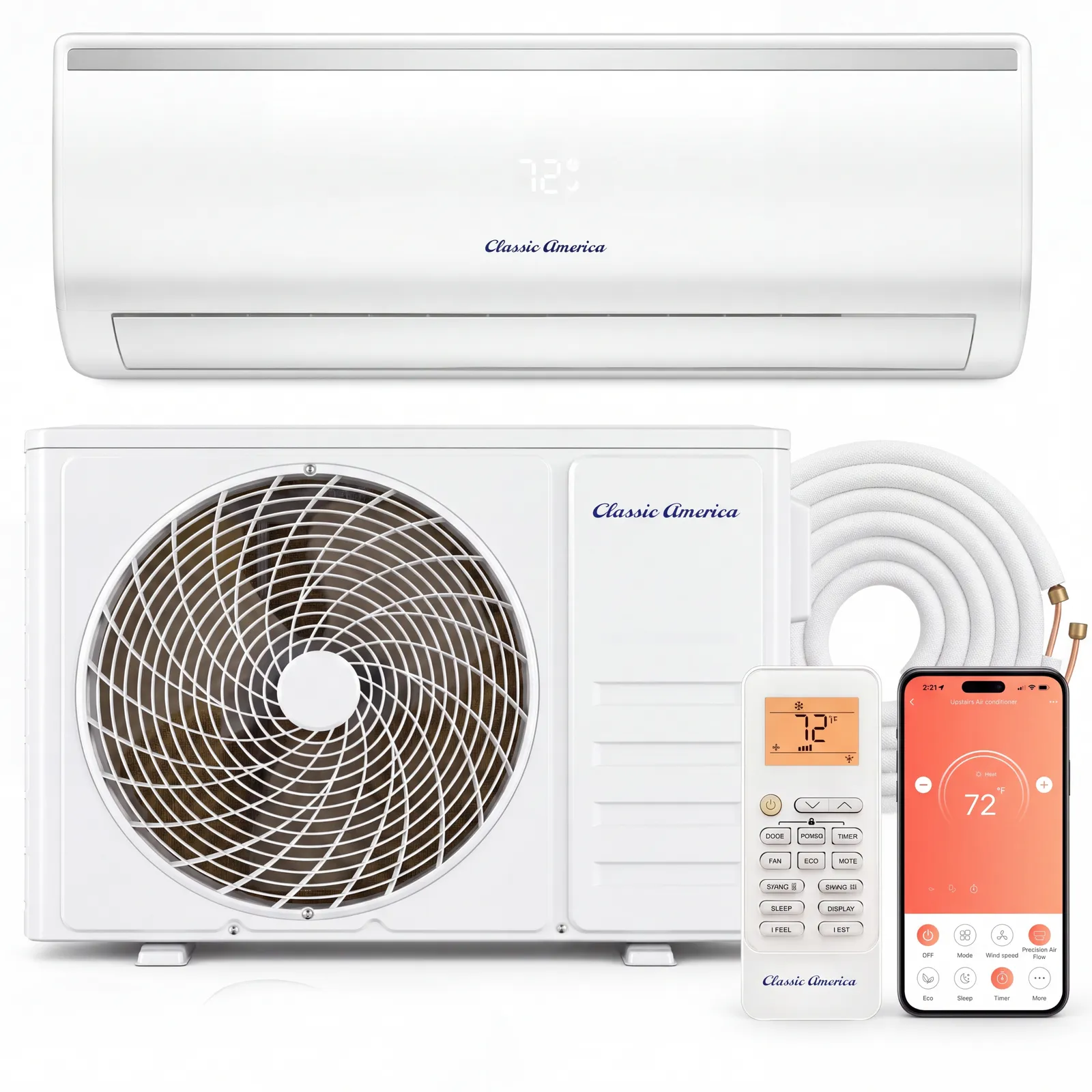
From the spec sheet
- 9,000 BTU/h cooling · 0.75 ton
- 23 SEER2
- 115V
- Up to 450 sq ft
- Heating nameplate 9,500 BTU/h
The 12,000 BTU class is not one coverage number
Both single-zone systems in this class are 115V heat pumps, and you'll find them on the 12,000 BTU hub. The 19 SEER2 model delivers the full 12,000 BTU/h and covers up to about 550 square feet. The 17 SEER2 model delivers 11,500 BTU/h and covers up to about 550 square feet. Choose based on your room's load and the spec sheet, not just the class name.
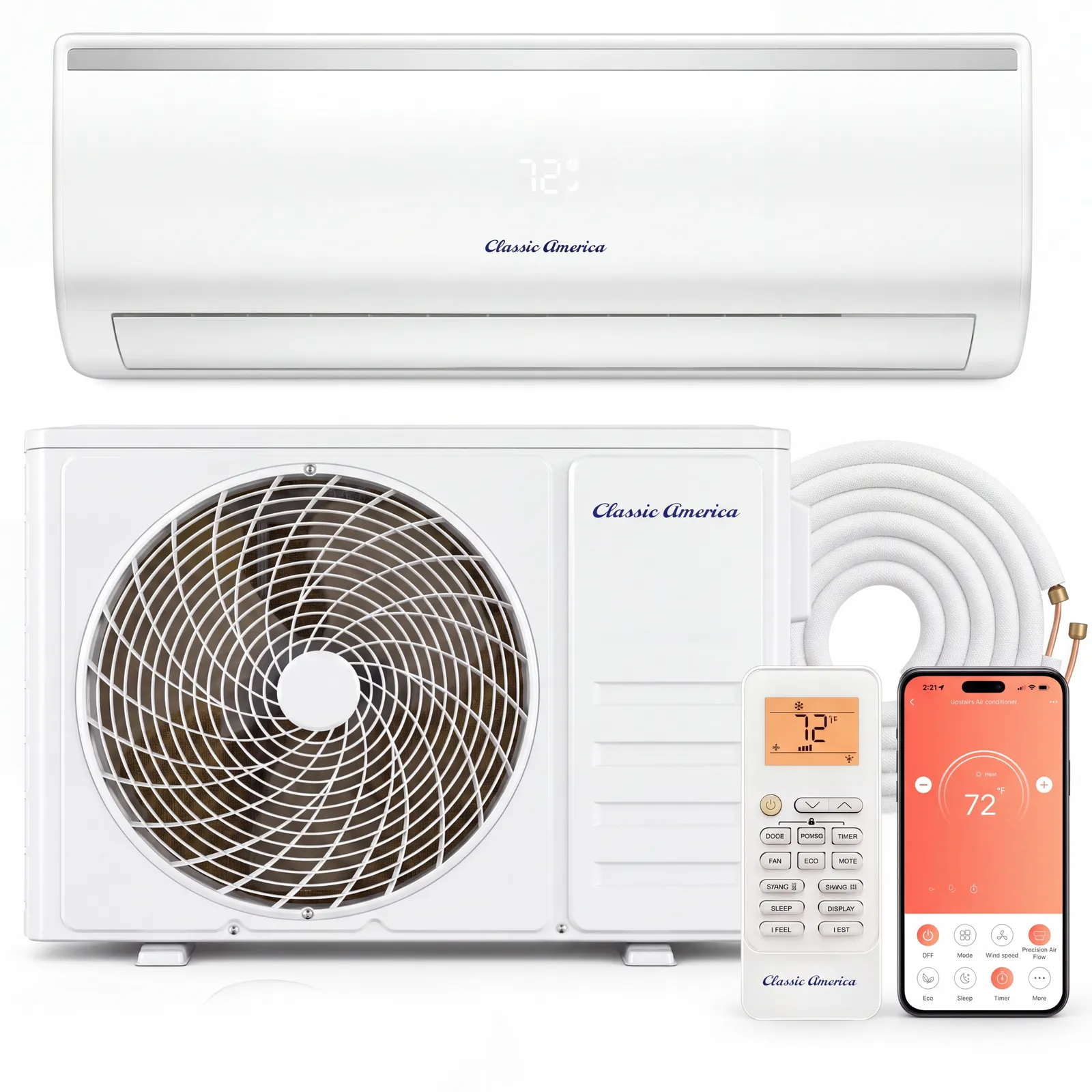
From the spec sheet
- 12,000 BTU/h cooling · 1 ton
- 19 SEER2
- 115V
- Up to 550 sq ft
- Heating nameplate 12,200 BTU/h
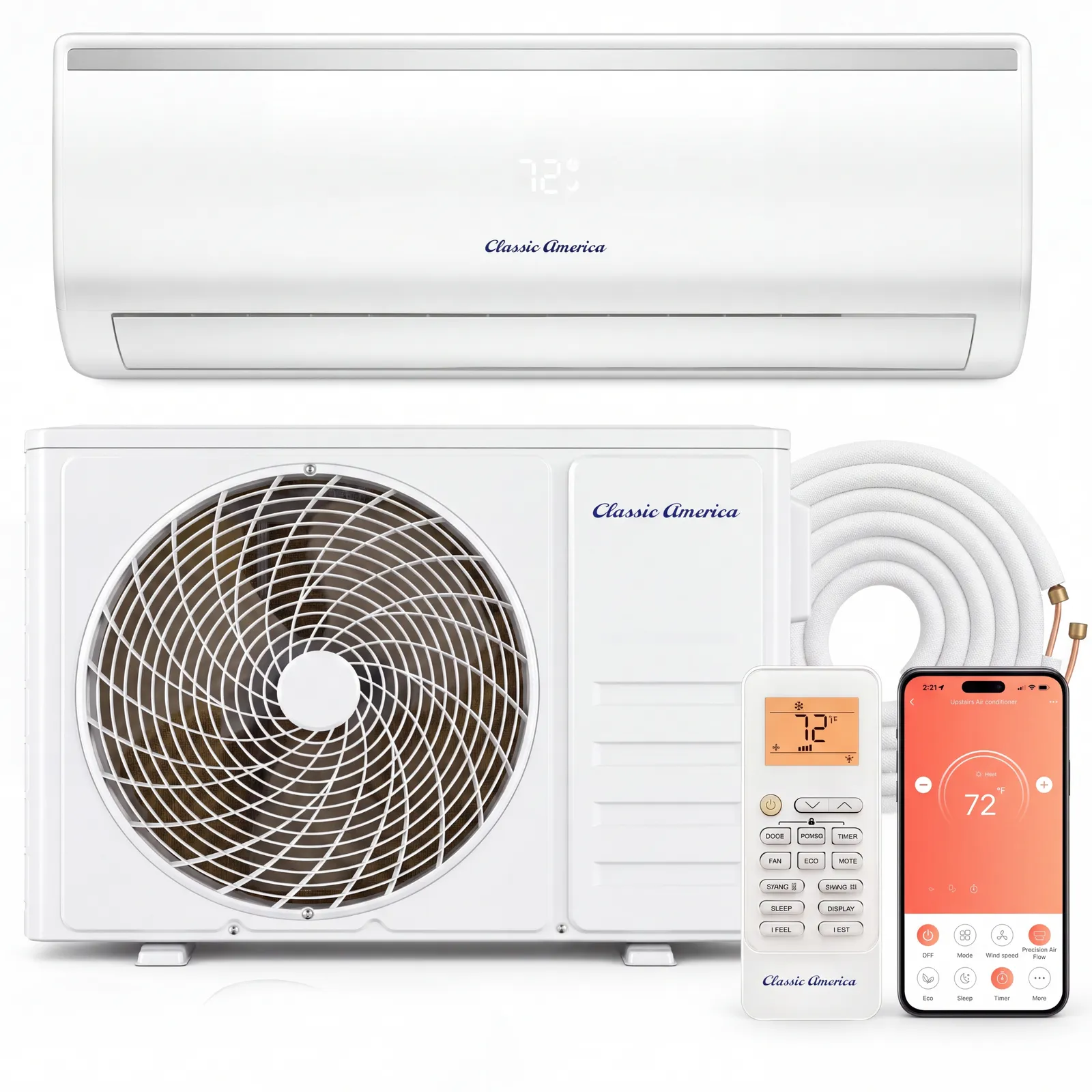
From the spec sheet
- 11,500 BTU/h cooling · 0.96 tons
- 17 SEER2
- 115V
- Up to 550 sq ft
- Heating nameplate 11,500 BTU/h
18,000 BTU is two heads
Eighteen thousand BTU/h is 1.5 tons of cooling, and in our lineup that's the DUET: one outdoor unit with two 9,000 BTU indoor heads. It's rated 24 SEER2 (non-ducted) on 208/230V. We don't publish a single square-foot figure for the pair, because two rooms rarely have the same load. Instead, run each room through the Size Finder. The dual-zone hub has the system page, and our upcoming dual zone mini split guide takes a longer look at sizing two rooms.
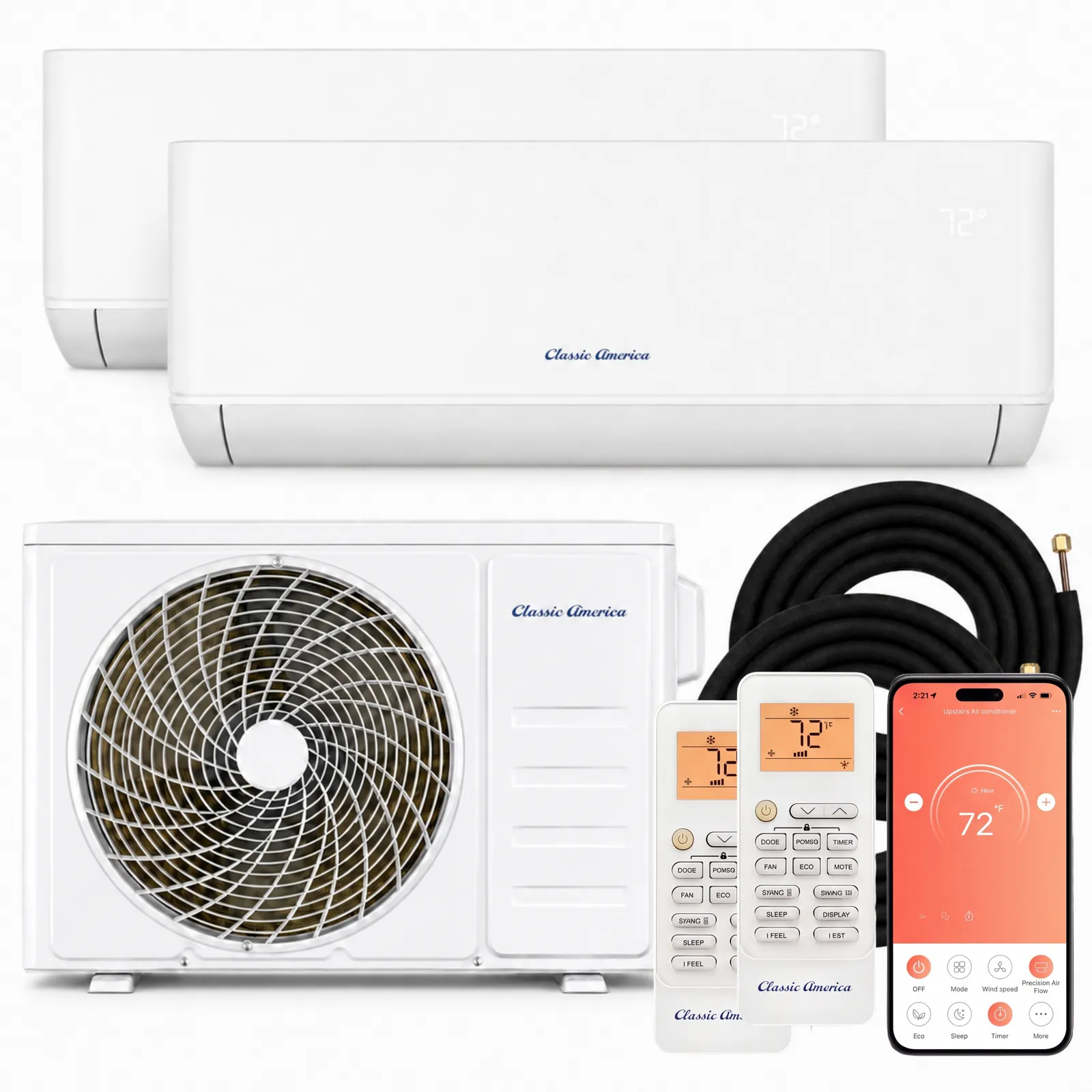
From the spec sheet
- 18,000 BTU/h cooling · 1.5 tons
- 24 SEER2, non-ducted
- 208/230V
- Two 9,000 BTU indoor heads on one outdoor unit
- Heating nameplate 20,000 BTU/h
The 23,000 BTU model is the 2 ton class
The 23,000 BTU mini split is our large single-zone heat pump: 23,000 BTU/h of cooling (about 1.9 tons), a heating nameplate of 22,400 BTU/h, and coverage up to 1,400 square feet. It runs on 208/230V rather than the 115V of our smaller single-zone systems, and it's rated 17 SEER2. You'll find it on the 23,000 BTU / 2 ton hub. If the Size Finder puts your room at 12,000 BTU or below, one of the smaller 115V systems is a closer match.
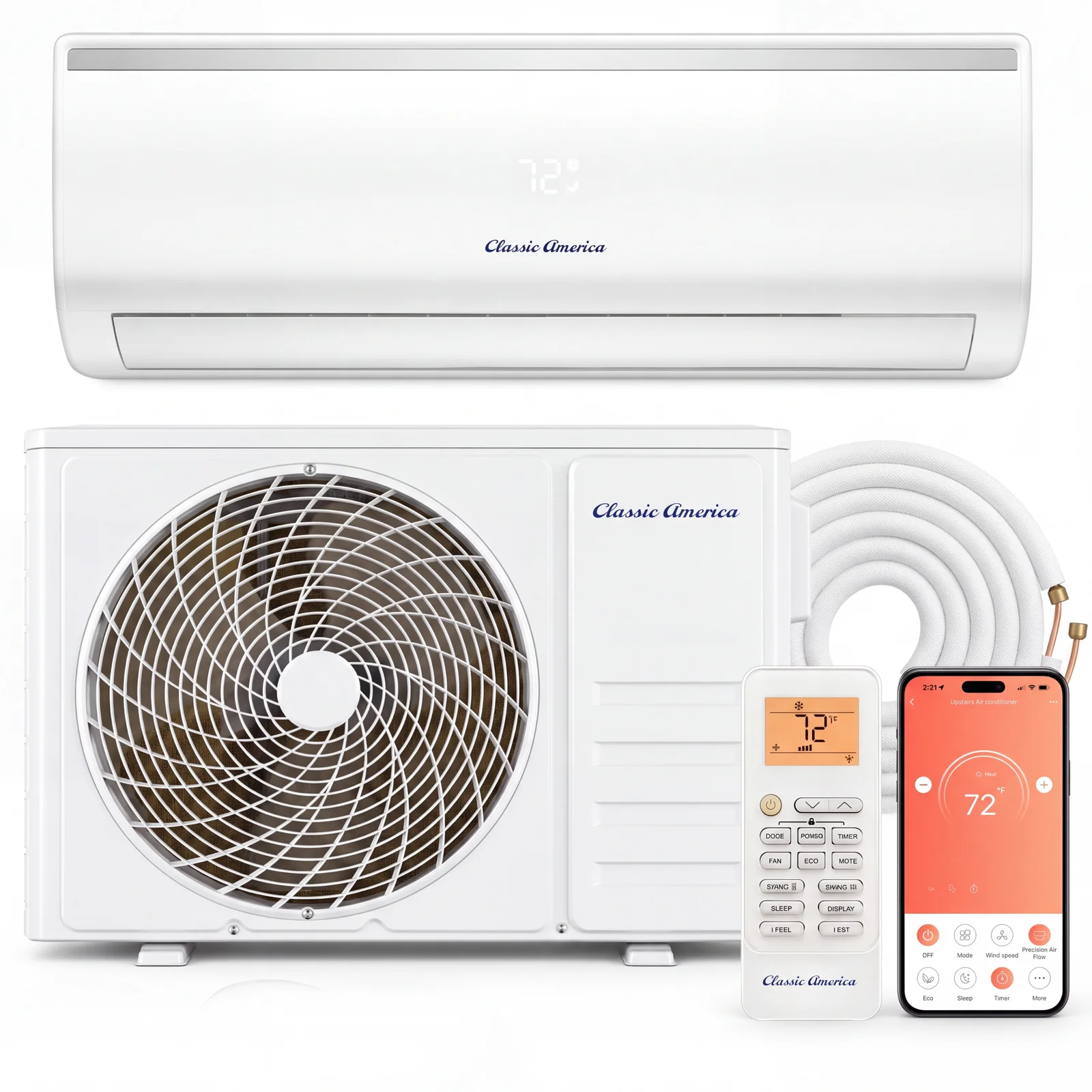
From the spec sheet
- 23,000 BTU/h cooling · 1.92 tons
- 17 SEER2
- 208/230V
- Up to 1,400 sq ft
- Heating nameplate 22,400 BTU/h

Square footage is only the starting row
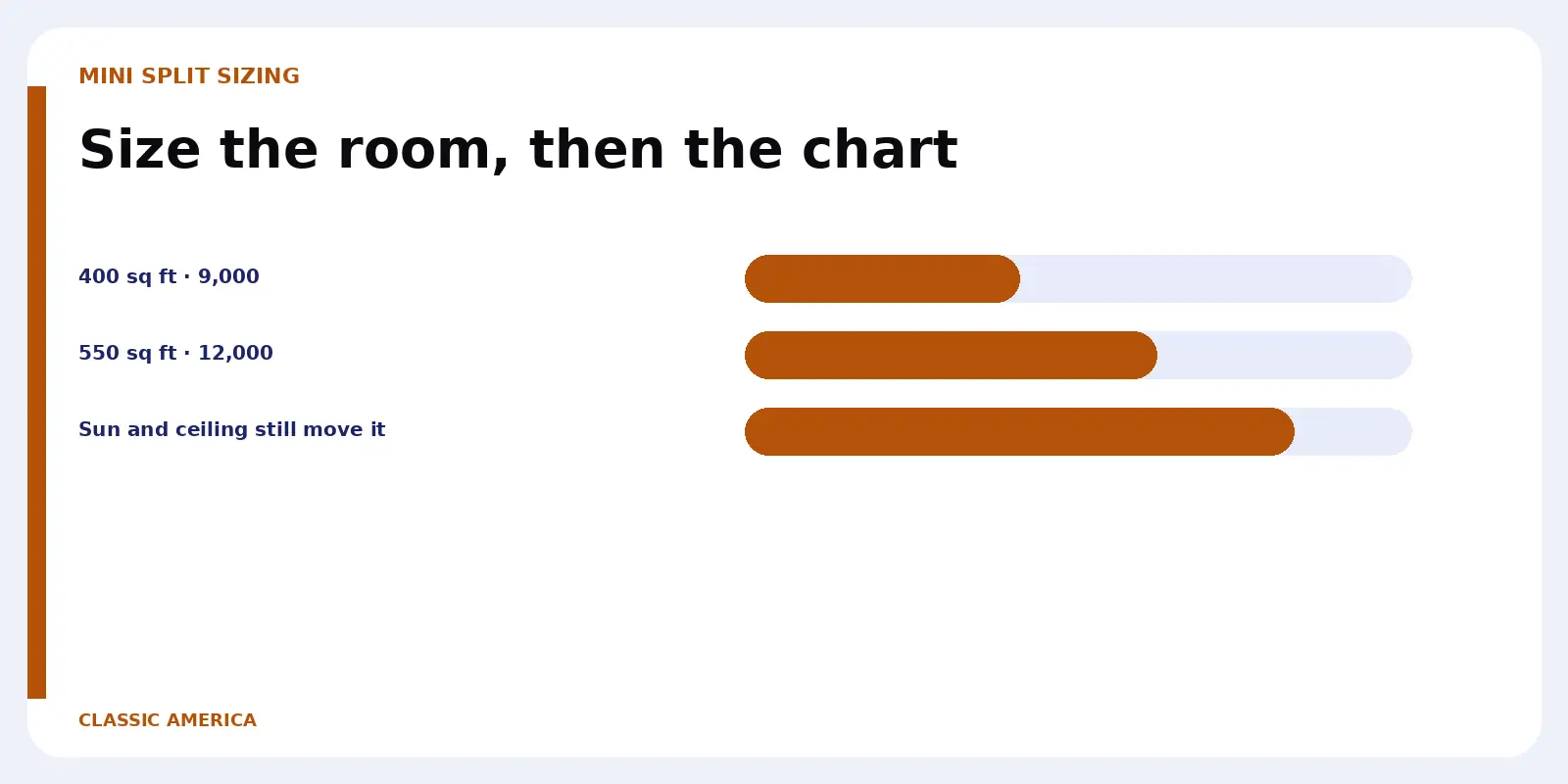
Lots of people size a mini split by square footage, because it's the only number they have handy. It's a real input, but it isn't the whole load. The Size Finder starts from the ENERGY STAR room chart for an 8-foot ceiling and average sun: about 250 square feet starts near 6,000 BTU of cooling, about 400 near 9,000, and about 550 near 12,000. Then it adjusts that number for the room you describe.
Those square-foot questions are all covered in this guide, so there's no need to hunt for separate posts. Whether you're asking about 500, 600, 800, or 1,000 square feet, you're in the right place, or check out mini split for a garage if the space is a garage. Run the calculator for your room rather than just multiplying square feet by 20. Our mini split BTU calculator walkthrough shows you how the tool works.
| Floor area | Ordinary room | What can move it |
|---|---|---|
| About 250 sq ft | Often the 9,000 BTU class at 8 ft and average sun | A kitchen adds cooking heat. The Size Finder adds 4,000 BTU for a kitchen. |
| About 400 sq ft | A step between 9,000 and 12,000. Heating can be the number that decides. | An average garage in that illustration can land near 13,400 BTU once heating is included. |
| About 550 sq ft | ENERGY STAR’s starting cooling figure is 12,000 BTU. The 19 SEER2 sheet says up to about 550 sq ft. | A tall ceiling, west glass, or a garage door is a different job. Do not read 550 as 600. |
Sun and glass change the same floor area
Afternoon sun through west- or south-facing glass adds heat that floor area alone won't show. The Size Finder treats a shaded room, a room with a typical window, and a sunny room differently. A sunroom is a bigger jump still, because the walls are mostly glass. If all you have is the square footage, you don't have the full picture of the load yet.
Shade can bump a borderline room down a size, and a wall of unshaded glass can bump it up. Neither one is a reason to skip the tool and buy the next size up “just in case.” An oversized unit can short-cycle and leave the room cool but damp. Our article on sizing and humidity explains that problem in more detail.
Ceiling height changes the air you are cooling
The ENERGY STAR starting chart assumes a ceiling of around 8 feet. The Size Finder scales the load with ceiling height, since a 10-foot ceiling means more air in the same footprint. A loft, a garage with open rafters, or a living room open to the floor above won't match the square-foot row on a chart.
Measure the ceiling height you actually have. Guessing “about 8” in a room that's really 10 feet is enough to undersize a borderline match. The calculator walkthrough shows you where that input goes.
Insulation and drafts
The chart assumes average insulation. An older, drafty room, a room above an unconditioned space, or a wall where you can feel the wind coming through will need more capacity than the same floor area with tight, well-insulated walls. On the flip side, good insulation can let a smaller size keep up. The tool covers all three levels. It's still an estimate, though, not a Manual J load calculation.
A garage door is the extreme case: a big, thin, leaky surface. Please don't size a garage from the living-room row. Check out mini split for a garage, and pick Garage or shop in the Size Finder.
Climate and heating
A hot, humid climate raises the cooling load, while in a cold climate, heating may be the number that decides the size. Most of our mini splits are heat pumps, but the cooling BTU isn't automatically the heat you'll get on a cold night. At mild outdoor temperatures, published heating is often close to cooling, and sometimes a little higher: 9,500 BTU/h on the 9,000 BTU system, 12,200 on the 19 SEER2 12,000 BTU system, 22,400 on the 23,000 BTU system, and 20,000 on DUET alongside 18,000 of cooling.
Those are nameplate numbers, not a promise at 5°F. The 9,000 BTU spec sheet lists 9,500 BTU/h of heating at 47°F, 8,000 at 19°F, and 7,000 at 5°F. Output drops as it gets colder, because there's less heat outside to move indoors. The Size Finder estimates heating as well as cooling when you tell it you need both. If the mini split will be your only heat source, have a licensed HVAC professional confirm the load. Our BTU to tons guide keeps the ton conversion separate from this heating detail.
Kitchens, people, and open plans
A kitchen adds heat that floor area doesn't show. Following the ENERGY STAR guidance, the Size Finder adds 4,000 BTU for cooking. A home office gets a small bump for equipment, and more than a couple of people in a room add heat too. An open floor plan that shares air with the kitchen counts as one load, not just the living-room rectangle.
Two closed rooms are the opposite challenge. One head can't reliably push air around a corner. That's a two-zone question (more on that below), not a reason to buy the biggest single head and hope for the best.
Numbers this chart won't stretch
- The 19 SEER2 model covers up to about 550 square feet, not 600. Its product web address still includes an older “600,” but the spec sheet doesn't.
- The 17 SEER2 model is in the 12,000 BTU class and publishes 11,500 BTU of cooling with coverage up to about 550 square feet.
- DUET’s 18,000 BTU comes from two 9,000 BTU heads. Its published non-ducted rating is 24 SEER2, not 24.5.
- The 23,000 BTU model is rated 17 SEER2. It isn't a 24,000 BTU head.
Two rooms are not one bigger head
If the Size Finder puts each of your two rooms near 9,000 BTU, DUET is made for that job: 18,000 BTU outdoors, two heads, 24 SEER2 non-ducted. If either room needs a 12,000 or 23,000 BTU head, a pair of 9,000 BTU heads isn't the right tool. Size each room, then read the dual zone mini split guide once it's live. In the meantime, the dual-zone hub shows the model we actually offer.
Voltage follows the size you land on
Just a heads-up: if your sizing result lands on the 23,000 BTU system, that's an electrical decision as well.
What you can plan, and what a pro handles
- Planning the mounting wall, where the outdoor unit will sit, and the path of the line set is great homeowner work.
- Refrigerant connections, pulling a vacuum, and a dedicated electrical circuit are jobs for a licensed HVAC professional.
- These systems come with a 5-year compressor warranty and 1 year on parts.
Equipment price is a separate question from this chart. Our guide to how much a mini split costs keeps commonly published US equipment ranges separate from installation. What a contractor charges to install it is covered in the upcoming mini split installation cost guide, and the delivery and installation guide shows what ships in the box.
Pop your room into the Size Finder: sun, ceiling, insulation, climate, and whether you need heat. Then match a model in the compare tool, or browse by capacity on the hubs. Have a question about a specific model? Give us a call at 1-800-349-4360 Ext. 204, Monday through Friday, 10 AM to 3 PM ET.
FAQ
Common questions
How do I size a mini split?
Start with the capacity class, then adjust for your room. In our lineup, 9,000 BTU/h covers up to about 450 sq ft, the 19 SEER2 12,000 BTU/h model covers up to about 550 sq ft, and the 23,000 BTU/h model covers up to 1,400 sq ft. Sun, ceiling height, insulation, and climate all change the load. Use the Size Finder for your actual room.
Is there a mini split sizing chart by square footage?
Yes, as a starting point. The ENERGY STAR chart behind the Size Finder assumes an 8-foot ceiling and average sun: about 400 square feet starts near 9,000 BTU of cooling, and about 550 near 12,000. The published coverage on a spec sheet is the same kind of clue. It isn't a promise for a sunny, tall, or poorly insulated room.
Is 12,000 BTU enough for 550 square feet?
On the 19 SEER2 spec sheet, 12,000 BTU/h is published for up to about 550 square feet under typical conditions. That's not 600, and it doesn't fit every 550 square-foot room. The 17 SEER2 model in the 12,000 BTU class publishes 11,500 BTU and up to about 550 square feet. A tall ceiling or west-facing glass can push a room past the 19 SEER2 row, so run the Size Finder.
Does ceiling height change mini split size?
Yes. The usual chart assumes about 8 feet. A higher ceiling means more air in the same footprint, and the Size Finder scales the estimate for that. Measure the height rather than guessing.
Can one mini split cool two rooms?
Not reliably, if the rooms are closed off from each other. DUET spreads 18,000 BTU across two 9,000 BTU heads, rated 24 SEER2 (non-ducted). Size each room. If either one needs more than a 9,000 BTU head, a pair of 9,000 BTU heads isn't the right match.
What if the Size Finder and the carton coverage disagree?
Go with the room. Box coverage is a note about typical conditions, while the Size Finder gives you an adjusted estimate. If they're close, you've probably got the right size. If the tool says one size above the box, don't ignore it to save money. And if the mini split will be your only heat, have a licensed HVAC professional confirm the load.